Equipment Health Monitoring for Manufacturing: Complete Guide to Protecting Your Assets

Your machines are talking. The question is whether you're listening. Equipment health monitoring transforms raw machine data into actionable intelligence — telling you not just what your equipment is doing right now, but predicting what it will do next. For manufacturers losing 5-20% of productive capacity to unplanned downtime, the difference between monitoring and not monitoring is often the difference between profit and loss.
What Equipment Health Monitoring Actually Means
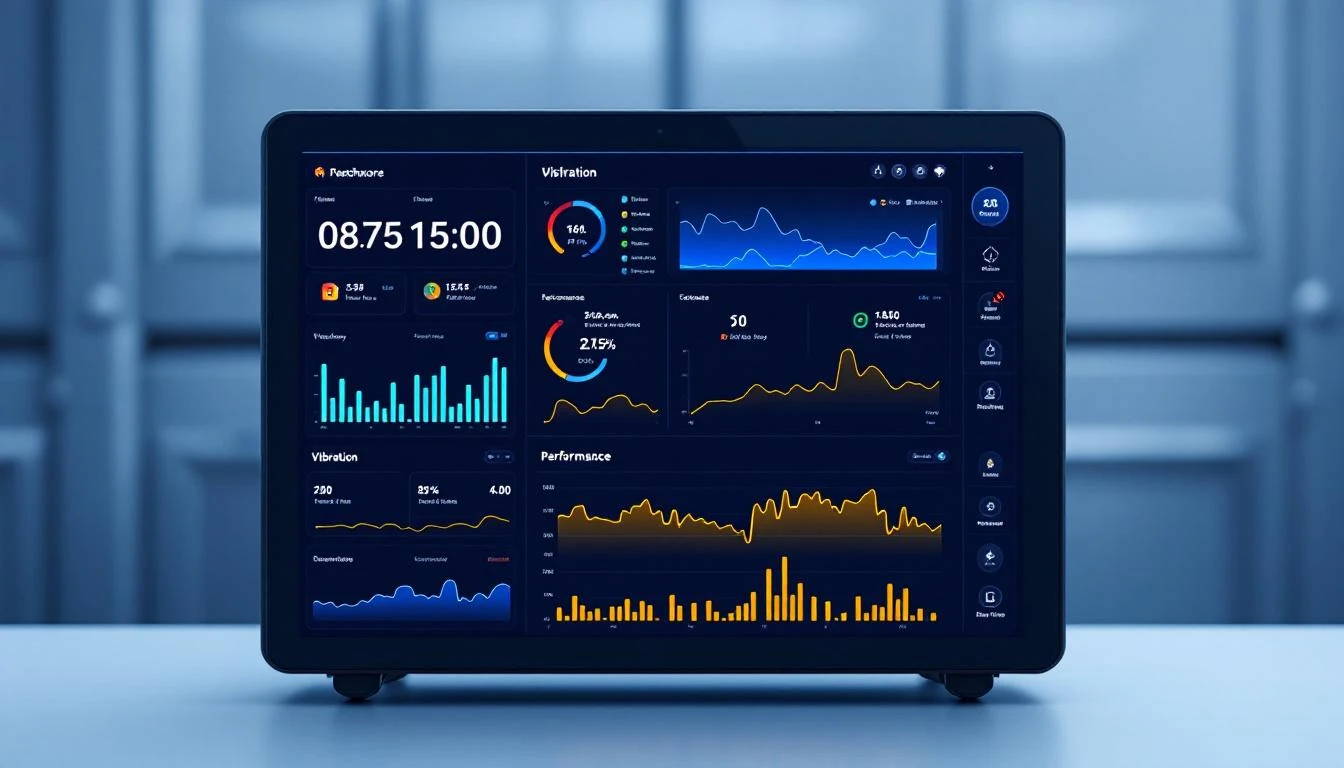
Equipment health monitoring is the continuous collection and analysis of operational data from manufacturing equipment to assess condition, detect degradation, and predict failures before they occur. It goes beyond simple "is the machine running?" status checks to answer deeper questions:
- Is this machine operating within normal parameters? — Comparing current performance to baseline
- Is anything degrading? — Detecting gradual changes in vibration, temperature, energy draw, or cycle time
- When will something fail? — Predicting remaining useful life based on degradation trends
- What's causing the degradation? — Root cause analysis through data correlation
- Which machines need attention first? — Prioritized risk scoring across your fleet
The goal isn't just data collection — it's converting data into maintenance decisions that prevent unplanned downtime.
The Five Pillars of Equipment Health
Comprehensive equipment health monitoring tracks multiple dimensions simultaneously. No single metric tells the complete story.
1. Vibration
Vibration analysis is the most established equipment health indicator. Changes in vibration signature can indicate:
- Bearing wear — Increased vibration at specific frequencies
- Misalignment — Axial or angular misalignment between coupled shafts
- Imbalance — Uneven mass distribution in rotating components
- Looseness — Mechanical looseness in mountings, bearings, or structural elements
- Cavitation — In pumps and hydraulic systems, cavitation creates distinct vibration patterns
Industry benchmark: According to ISO 10816 (now ISO 20816), vibration velocity above 7.1 mm/s indicates a "danger" state for most Class II industrial machines. Monitoring trends well before this threshold is where value lies.
2. Temperature
Thermal monitoring provides critical health indicators:
- Bearing temperature — Rising temperatures indicate increasing friction from wear or contamination
- Motor winding temperature — Overheating windings suggest insulation degradation or overloading
- Hydraulic fluid temperature — Elevated temperatures accelerate oil degradation and component wear
- Ambient vs. operating differential — Increasing differential at constant load signals efficiency loss
Key insight: Temperature changes are often the first visible symptom of developing problems. A bearing that's running 15°C hotter than baseline may have months before failure — but the trend tells you to plan the replacement now.
3. Energy Consumption
Power draw per machine is an underutilized health metric:
- Baseline power at standard load — Establishing normal energy consumption per operating condition
- Power increases at constant load — Rising consumption indicates mechanical resistance (bearing wear, misalignment, contamination)
- Power spikes — Intermittent spikes suggest intermittent faults or material feed issues
- Idle power draw — Unexpectedly high idle power can indicate electrical issues or brake drag
Real-world impact: A McKinsey study found that energy-aware maintenance strategies can reduce energy consumption by 5-15% while simultaneously improving equipment reliability.
4. Cycle Time and Production Metrics
Production performance is itself a health indicator:
- Cycle time drift — Gradually lengthening cycle times often indicate mechanical wear or hydraulic degradation
- Reject rate changes — Increasing defect rates correlate with equipment condition
- Throughput variation — Unexplained production rate changes signal developing issues
- Startup time — Machines taking longer to reach operating conditions may have thermal management or control issues
5. Alarm Patterns
Machine fault codes and alarms contain rich diagnostic information:
- Alarm frequency trends — Increasing alarm rates indicate system instability
- Alarm type patterns — Repeated alarms of the same type point to specific subsystem issues
- Alarm-to-downtime correlation — Which alarms predict production stops?
- Cross-machine alarm patterns — Similar alarms across machine types may indicate environmental or material issues

Monitoring Methods: Sensors vs. PLCs
Two fundamentally different approaches exist for collecting equipment health data.
The Sensor Overlay Approach
Add dedicated monitoring sensors (vibration, temperature, acoustic) to each machine. These sensors feed data to a monitoring platform.
Advantages:
- Can monitor equipment without modern controllers
- Specialized sensors may capture data PLCs don't
- Independent from machine control systems
Disadvantages:
- Per-machine hardware cost
- Physical installation required
- Limited to what the sensor measures (usually vibration + temperature)
- Sensor maintenance and replacement adds ongoing cost
- Network connectivity required per sensor
- No access to production data (cycle counts, alarms, process parameters)
The Protocol-Native Approach
Connect to existing PLCs and industrial controllers that already run your equipment, reading every data tag they generate.
Advantages:
- Zero additional sensors — PLCs already collect comprehensive data
- Minutes to deploy — connect edge device to PLC network
- Complete data access — every tag the controller tracks becomes visible
- Production + health data combined — cycle counts, alarms, AND operating parameters
- No per-machine hardware scaling
- Cellular connectivity eliminates IT network involvement
Disadvantages:
- Requires PLC-equipped machinery
- Data resolution limited to PLC scan rates (typically sufficient for health monitoring)
- Some specialized measurements (acoustic analysis) require dedicated sensors
For most modern manufacturing plants, the protocol-native approach delivers superior results at lower cost. Your PLCs are already measuring temperature, pressure, speed, vibration (through accelerometer cards), energy draw, and dozens of other parameters. Adding external sensors to duplicate this data is unnecessary expense.
Building an Equipment Health Monitoring Program
Phase 1: Critical Asset Identification
Not every machine deserves equal monitoring attention. Prioritize based on:
- Production impact — What happens if this machine stops? How many downstream operations are affected?
- Failure frequency — Machines with frequent failures have the most to gain from monitoring
- Repair cost — High repair cost machines justify monitoring investment more readily
- Replacement lead time — If spare parts take 12 weeks to arrive, early warning is especially valuable
- Safety implications — Any machine whose failure creates safety risk gets top priority
Practical approach: Start with your top 10-20 critical machines. Demonstrate ROI, then expand systematically.
Phase 2: Baseline Establishment
Before you can detect abnormal behavior, you need to define normal. Establish baselines for each monitored machine:
- Operating parameters at standard load — Temperature, vibration, energy draw during normal production
- Startup and shutdown profiles — Normal startup duration and parameter ramp
- Shift-to-shift variation — Normal differences between operating conditions
- Seasonal variation — Ambient temperature effects on equipment performance
- Post-maintenance baselines — Updated baselines after major maintenance actions
Baseline period: Allow 2-4 weeks of normal operation to establish reliable baselines. Include different operating conditions (full load, partial load, different products) to build a comprehensive normal profile.
Phase 3: Threshold and Alert Configuration
Convert baseline knowledge into actionable alerting:
- Warning thresholds — "Approaching" alerts that indicate trends worth watching (e.g., temperature 10% above baseline)
- Critical thresholds — "Active" alerts that require immediate attention (e.g., vibration exceeding ISO 10816 limits)
- Rate-of-change alerts — Detect rapid changes even if absolute values are still within range
- Cross-parameter alerts — Correlate multiple metrics (temperature AND vibration rising together suggests different root cause than temperature alone)
Practical tip: Start with conservative (wider) thresholds and tighten over time as you learn your equipment. Too many false alarms early in deployment will erode team trust in the system.
Phase 4: Predictive Model Development
Once you have historical data, AI-powered analysis can move beyond simple thresholds to genuine prediction:
- Degradation curve modeling — Predict remaining useful life based on observed degradation rate
- Failure pattern recognition — Identify data signatures that preceded past failures
- Seasonal and environmental correlation — Adjust predictions based on operating conditions
- Cross-fleet learning — Apply failure patterns from one machine to similar equipment
This is where platforms with AI capabilities like MachineCDN differentiate from basic monitoring tools. Thresholds tell you when something IS wrong. AI tells you when something is GOING to go wrong.
Phase 5: Maintenance Integration
Equipment health monitoring creates value only when insights drive maintenance actions. This requires:
- Automated PM task creation — When monitoring detects a developing issue, a maintenance task should be created automatically
- Spare parts availability check — Before scheduling maintenance, verify required parts are in stock
- Priority-based scheduling — Rank maintenance tasks by risk level and production impact
- Closed-loop verification — After maintenance, verify through monitoring data that the issue is resolved
Platforms that integrate monitoring with preventive maintenance scheduling and spare parts tracking — like MachineCDN — close this loop natively. Standalone monitoring platforms create a data silo that requires manual translation into maintenance actions.
Metrics That Matter
Equipment-Level Metrics
- Mean Time Between Failures (MTBF) — Increasing MTBF = improving equipment health
- Mean Time To Repair (MTTR) — Decreasing MTTR = better maintenance preparation
- Health Score — Composite index (0-100) combining multiple parameters
- Remaining Useful Life (RUL) — Predicted time until maintenance is needed
- Alarm Rate — Alarms per operating hour, trended over time
Fleet-Level Metrics
- Fleet Availability — Percentage of monitored equipment in normal operating state
- Capacity Utilization — Actual production vs. maximum production capacity
- Maintenance Backlog — Volume of identified issues awaiting maintenance action
- Prediction Accuracy — Percentage of predicted failures that were accurate (measures AI model quality)
Business Metrics
- Unplanned Downtime Reduction — The primary ROI metric for most manufacturers
- Maintenance Cost per Unit Produced — Normalizes maintenance spending to production volume
- Energy Cost per Unit — Identifies equipment efficiency degradation
- Parts Consumption Trend — Declining spare parts usage indicates healthier equipment
Choosing an Equipment Health Monitoring Platform
Must-Have Capabilities
- Protocol-native PLC connectivity — Direct connection to Siemens, Rockwell, ABB, and other major PLC brands
- Real-time monitoring — Live machine status, not batch data uploads
- Threshold alerting with approaching views — Catch developing issues before they become critical
- AI-powered anomaly detection — Go beyond static thresholds to detect subtle degradation
- Integrated maintenance management — PM scheduling and spare parts tracking alongside monitoring
- Fleet management — Multi-location, multi-zone visibility for distributed operations
- Rapid deployment — Minutes to connect, not months
Nice-to-Have Capabilities
- Materials and inventory tracking
- Energy consumption monitoring per machine
- Custom report builder with tag selection
- Downtime reason categorization and analysis
- Mobile access for maintenance teams
Red Flags in Vendor Evaluation
- "Requires 6+ months to implement" — Modern IIoT platforms deploy in minutes, not months
- Per-tag or per-point pricing — Encourages monitoring fewer data points to control costs
- Proprietary sensor requirements — Creates vendor lock-in and hardware dependency
- No maintenance integration — Monitoring without action capability creates a data silo
- Cloud-only with no edge processing — Some data processing should happen at the edge for latency-sensitive alerting
Getting Started
The most effective way to start equipment health monitoring is to begin small and prove value fast:
- Identify your top 5 critical machines — The ones where downtime costs the most
- Connect a protocol-native platform — MachineCDN connects in 3 minutes per device with zero IT involvement
- Establish baselines — 2-4 weeks of normal operation data
- Configure initial thresholds — Start conservative, tighten over time
- Track the first prevented downtime event — This is your ROI proof point
- Expand systematically — Add machines based on criticality ranking
Most manufacturers who start with 5-10 machines have their ROI case for full deployment within 5 weeks.
Book a demo to see protocol-native equipment health monitoring with your actual machine data.
Related reading: