How to Implement Predictive Maintenance: A Step-by-Step Guide for Manufacturing Plants

Predictive maintenance isn't a futuristic concept anymore — it's the standard that separates world-class manufacturing operations from the ones bleeding money on unplanned downtime. If your plant still runs on reactive or calendar-based maintenance, you're leaving between 10% and 40% of your maintenance budget on the table, according to the U.S. Department of Energy.
This guide walks you through exactly how to implement predictive maintenance in a real manufacturing environment — no academic theory, no vendor hand-waving. Just practical steps from someone who's done it.

Why Predictive Maintenance Matters More in 2026
The math hasn't changed, but the urgency has. Unplanned downtime in manufacturing costs an estimated $50 billion annually across the industry. For a mid-sized discrete manufacturer running two shifts, a single hour of unplanned downtime can cost $10,000 to $250,000 depending on the line.
What has changed is the technology. Five years ago, implementing predictive maintenance required a team of data scientists, a six-figure consulting engagement, and 12 months of integration work. Today, platforms like MachineCDN can get your first machines connected and generating predictive insights in weeks, not quarters.
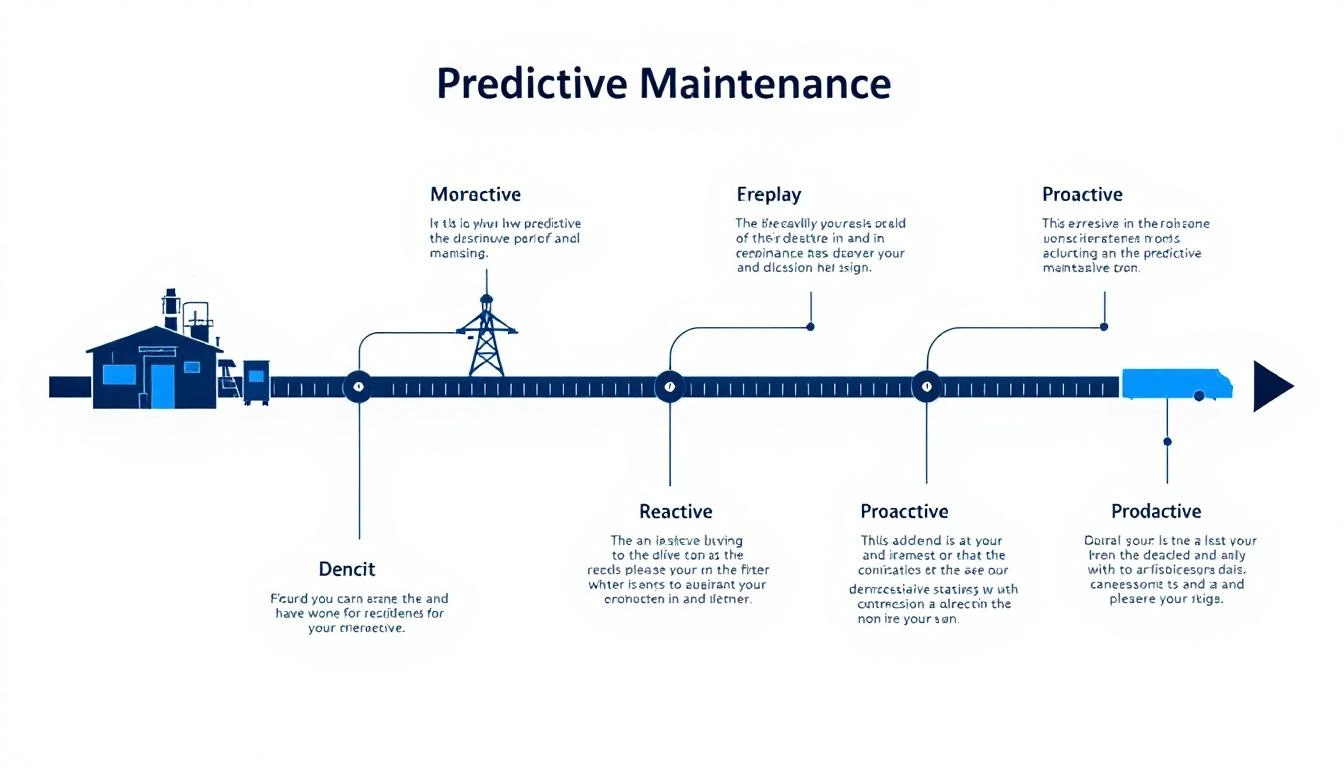
Here's what the maturity model looks like:
- Reactive maintenance: Fix it when it breaks. Highest total cost, worst uptime.
- Preventive (calendar-based): Replace parts on a schedule. Better, but you're still replacing components that have life left.
- Condition-based: Monitor key parameters and act when thresholds are crossed. Good, but limited.
- Predictive: Use historical data + AI to forecast failures before they happen. Optimal cost and uptime.
- Prescriptive: AI not only predicts when a failure will occur but recommends the specific action. The cutting edge.
Most plants are somewhere between reactive and preventive. The goal is to leap to predictive — and the good news is you don't need to do it all at once.
Step 1: Identify Your Critical Assets
Don't try to instrument every machine on day one. That's the fastest way to burn budget and lose organizational support.
Start with a criticality assessment. Rank your equipment on three dimensions:
Impact of failure:
- What's the cost per hour of downtime for this machine?
- Does it create a single point of failure for the entire line?
- Are there safety implications?
Current failure patterns:
- How often does this machine experience unplanned stops?
- What's the mean time between failures (MTBF)?
- What are the most common failure modes?
Monitoring feasibility:
- Can we access the PLC or controller data?
- Are there existing sensors we can tap into?
- Is the machine accessible for retrofit?
For most plants, your top 5-10 critical assets will account for 60-80% of your total downtime impact. Start there.
Pro tip: Pull your CMMS work order history for the last 12 months. Sort by total downtime hours per asset. That's your shortlist.
Step 2: Define What You're Predicting
This is where most implementations go wrong. "Predictive maintenance" is not a single thing — it's a strategy that targets specific failure modes on specific equipment.
For each critical asset, document:
- Primary failure modes: Bearing wear, seal leaks, overheating, vibration anomalies, pressure loss
- Leading indicators: What measurable parameters change before the failure occurs?
- Warning timeline: How much advance notice do you need to plan a repair? (24 hours? 7 days? 30 days?)
- Required data: Temperature, vibration, current draw, pressure, cycle counts, runtime hours
For a CNC spindle, for example, you might target bearing failure by monitoring vibration frequency spectrum and temperature delta. The leading indicator is a shift in vibration harmonics 2-4 weeks before catastrophic failure.
For a hydraulic press, you'd watch pressure consistency, oil temperature, and cycle time variance. Pressure fluctuation outside normal range often precedes seal failures by 1-2 weeks.
Step 3: Instrument Your Machines
Now comes the physical layer. You have two paths:
Path A: PLC/Controller Data (Preferred)
If your machines have modern PLCs (Allen-Bradley, Siemens, Mitsubishi, Omron), you already have a goldmine of data sitting in the controller that's never been collected.
Most PLCs track:
- Motor current and voltage
- Temperature readings from RTDs and thermocouples
- Pressure transducers
- Cycle counts and runtime hours
- Alarm states and fault codes
- Analog inputs from existing sensors
The fastest path is an edge gateway that connects to your PLC via Ethernet/IP or Modbus and streams data to the cloud. MachineCDN's edge devices, for example, can connect to a PLC and start streaming data in under 3 minutes — no plant network configuration required because they use cellular connectivity.
Path B: Retrofit Sensors
For older machines without accessible controllers, you'll need to add sensors. Common retrofit options:
- Vibration sensors: Triaxial accelerometers mounted on bearing housings ($200-500 each)
- Temperature sensors: Non-contact IR sensors or surface-mount thermocouples ($50-200 each)
- Current transformers: Clamp-on CTs for motor current monitoring ($100-300 each)
- Pressure transducers: Inline sensors for hydraulic/pneumatic systems ($200-400 each)
Budget $1,000-3,000 per machine for a basic sensor retrofit, plus the edge gateway.
Connectivity Matters
Here's a lesson learned the hard way by many plants: don't connect your IIoT platform to your plant network.
IT/OT convergence sounds great in conference presentations. In practice, it means:
- 6 months of security reviews before anything gets approved
- Firewall rules that break your data flow
- Network outages that take your monitoring offline
- IT teams that don't understand manufacturing urgency
The smarter approach is cellular connectivity. An industrial cellular gateway bypasses the plant network entirely, sends data directly to the cloud, and removes IT from the critical path. This is exactly how MachineCDN's architecture works — and it's the primary reason plants can go live in weeks instead of months.
Step 4: Establish Your Baseline
You can't predict anomalies without knowing what "normal" looks like.
Run your instrumented machines in normal production for 2-4 weeks. During this period:
- Collect continuous data at your chosen sample rate (1-second intervals for vibration, 5-15 seconds for temperature and pressure is typical)
- Log all maintenance events — both planned and unplanned
- Document operating conditions — production schedule, product mix, environmental factors
- Tag data quality issues — sensor dropouts, communication gaps, calibration needs
This baseline period is non-negotiable. Machine learning models trained on insufficient baseline data produce garbage predictions. Two weeks is the minimum; four weeks captures weekly production cycle variations.
During baselining, you should also set your initial threshold alerts. Even before your predictive models are ready, simple threshold monitoring will catch the obvious problems — an overheating motor, a pressure spike, a vibration level that's clearly outside normal range.
Step 5: Build Your Predictive Models
This is where the AI layer comes in. You have three approaches, from simple to sophisticated:
Statistical Process Control (Simplest)
Calculate control limits (mean ± 3σ) for each monitored parameter. Flag any data point that crosses the control limit. This isn't truly "predictive," but it catches deterioration trends early.
Best for: Plants just starting out, parameters with linear degradation patterns.
Machine Learning Classification
Train a classifier (random forest, gradient boosting, or neural network) on your historical data, labeled with failure events. The model learns the signature patterns that precede failures.
Best for: Equipment with well-documented failure history, plants with data science capability.
AI-Powered Anomaly Detection (Recommended)
Modern IIoT platforms use unsupervised anomaly detection — the system learns normal behavior and flags deviations without needing labeled failure data. This is how MachineCDN's AI engine works, powered by Azure OpenAI integration.
Best for: Most plants. Doesn't require extensive failure history. Adapts to changing operating conditions.
The advantage of a platform approach is that you don't need to build and maintain these models yourself. You focus on the manufacturing knowledge (what the data means), and the platform handles the data science.
Step 6: Integrate with Your Maintenance Workflow
A predictive alert that nobody acts on is worthless. The implementation only works if predictions connect directly to your maintenance execution process.
Required integrations:
- CMMS / Work Order System: Predictive alerts should automatically generate work orders with the predicted failure mode, recommended action, and estimated time to failure.
- Spare Parts Inventory: If you predict a bearing failure in 14 days, does your stockroom have the bearing? MachineCDN's spare parts tracking closes this loop.
- Production Schedule: Can you slot the repair into a planned changeover or weekend? Planned downtime costs a fraction of unplanned.
- Escalation Paths: What happens if a critical prediction is ignored? Define escalation: alert → supervisor notification → production manager → plant manager.
Step 7: Measure and Optimize
Track these KPIs from day one:
| KPI | Baseline (Before) | Target (6 Months) | World Class |
|---|---|---|---|
| Unplanned Downtime % | Measure current | -30% | Under 2% of operating time |
| MTBF (Mean Time Between Failures) | Measure current | +25% | Equipment-specific |
| Maintenance Cost per Unit | Measure current | -20% | Industry benchmark |
| PdM Work Orders as % of Total | 0% | 40% | >70% |
| Prediction Accuracy | N/A | >70% | >90% |
The ROI timeline: Most plants using modern IIoT platforms see payback within 5-8 weeks. The first prevented unplanned stop usually covers the cost of the entire initial deployment. MachineCDN customers report 5-week ROI on average, primarily driven by the cellular connectivity model that eliminates the lengthy IT integration phase.
Common Implementation Mistakes
After seeing dozens of predictive maintenance implementations, here are the patterns that kill projects:
- Boiling the ocean: Trying to instrument 200 machines at once. Start with 5-10 critical assets and expand.
- Ignoring the people: Maintenance techs need training and buy-in. If they don't trust the system, they'll ignore the alerts.
- Over-engineering the models: Start with threshold alerts, graduate to anomaly detection. You don't need a PhD-level model on day one.
- No feedback loop: If a prediction was wrong, feed that back into the model. Continuous improvement applies to AI too.
- Plant network dependency: Every project that routes through the plant IT network adds 3-6 months. Use cellular.
What a Realistic Timeline Looks Like
| Phase | Duration | Activities |
|---|---|---|
| Assessment & Planning | 2 weeks | Criticality analysis, sensor selection, platform evaluation |
| Procurement & Installation | 1-2 weeks | Edge gateways, sensors, platform setup |
| Baselining | 2-4 weeks | Data collection, threshold configuration |
| Initial Predictions | 4-8 weeks | First predictive models active, initial alerts |
| Optimization | Ongoing | Model refinement, expansion to more assets |
Total time from decision to first predictive insight: 5-10 weeks with a modern platform. Compare that to the 12-18 months typical of legacy approaches.
Getting Started
The hardest part of implementing predictive maintenance isn't the technology — it's the decision to start. Pick your five most critical machines, connect them to a modern IIoT platform, and let the data tell you what your equipment is trying to say.
Book a demo with MachineCDN to see how manufacturers are going from zero to predictive maintenance in under 6 weeks — with 3-minute device setup, zero IT involvement, and AI-powered insights from day one.
Related reading: