The Complete Guide to IIoT for Plastics Manufacturers: From Injection Molding to Extrusion to Blow Molding

The plastics manufacturing industry processes over 400 million metric tons of polymer annually worldwide. Yet the vast majority of plastics processors — from custom injection molders running 20 presses to multi-plant extrusion operations with hundreds of lines — still operate with minimal real-time data from their machines.
This isn't because the technology doesn't exist. It's because the IIoT industry has historically sold solutions designed for discrete manufacturing and tried to force-fit them into the continuous, batch, and hybrid process world of plastics.
This guide is different. It's written specifically for plastics manufacturers — covering injection molding, extrusion, blow molding, thermoforming, and secondary operations. Whether you're evaluating your first IIoT pilot or scaling monitoring across multiple facilities, this is your roadmap.

What Is IIoT for Plastics Manufacturing?
The Industrial Internet of Things (IIoT) in plastics manufacturing means connecting your production equipment — presses, extruders, blow molding machines, auxiliary equipment — to a unified data platform that collects, analyzes, and acts on machine data in real time.
At its core, IIoT for plastics does three things:
- Collects data from PLCs, sensors, and machine controllers via industrial protocols (Ethernet/IP, Modbus TCP/RTU)
- Analyzes that data in the cloud using AI, machine learning, and statistical process control
- Acts by alerting operators, predicting failures, and optimizing process parameters
But the specific what you monitor, why it matters, and how you implement it varies dramatically by plastics process type. An injection molding press and a twin-screw extruder have almost nothing in common from a data perspective — different cycle characteristics, different failure modes, different KPIs.
That's why generic IIoT guides fall short for plastics. Let's break it down by process.
IIoT for Injection Molding
Injection molding is the most common plastics process, accounting for roughly 30% of all plastics by volume. It's also the most data-rich — a modern injection press generates dozens of process parameters every cycle, with cycle times as short as 5–10 seconds for thin-wall packaging.
Critical Parameters to Monitor
Process Parameters (Every Cycle)
- Melt temperature (barrel zones 1–5+)
- Injection pressure (peak, pack, hold)
- Injection speed and velocity profile
- Cushion position (shot-to-shot consistency)
- Cooling time and mold temperature
- Clamp tonnage (actual vs. set)
- Screw recovery time and back pressure
Machine Health Parameters (Continuous)
- Hydraulic oil temperature and pressure
- Toggle pin wear indicators
- Tie bar strain (clamp force distribution)
- Motor current draw (trending = degradation)
- Cooling water flow and temperature differential
Quality-Linked Parameters
- Shot weight (correlates to fill consistency)
- Cycle time deviation from standard
- Part ejection force (sticking = quality issue)
For a detailed deep-dive into injection molding monitoring, see our guide: IoT Monitoring for Injection Molding Machines: Catching Process Drift Before Defects.
The Value of Cycle-Level Data in Injection Molding
What makes IIoT transformational for injection molding isn't just collecting data — it's collecting it at cycle-level granularity. When a 300-ton press runs a 30-second cycle 24/7, it produces 2,880 cycles per day. Each cycle generates a data snapshot.
Traditional quality approaches check parts every hour or every 100 shots. IIoT monitors every single cycle. This means:
- Process drift detection — You see the trend developing 200 cycles before the first bad part
- Correlation analysis — When scrap spikes, you can look back at exactly which parameter shifted and when
- Mold-specific baselines — Different molds on the same press have different "normal" profiles. IIoT platforms track this automatically.
IIoT for Extrusion
Extrusion is fundamentally different from injection molding. Instead of discrete cycles, extrusion is a continuous process — a line might run for 48 hours straight producing pipe, profile, film, or sheet. The monitoring approach must reflect this.
Critical Parameters for Extrusion Monitoring
Barrel and Die Temperatures Extrusion lines have 5–12+ temperature zones from feed throat to die. Each zone must maintain its setpoint within tight tolerances — typically ±2°C for precision extrusion. Temperature deviations cause:
- Surging (melt viscosity changes)
- Dimensional variation
- Surface defects (shark skin, melt fracture)
- Degradation (residence time × temperature)
Screw and Motor Parameters
- Screw RPM and stability
- Motor current draw (increasing current at constant RPM = screw/barrel wear)
- Back pressure
- Melt pressure at the die
Downstream Equipment
- Haul-off speed (must synchronize with throughput)
- Cooling bath temperatures
- Dimensional measurements (laser micrometers, inline gauging)
- Cutter speed and cut length accuracy
For the complete guide to extrusion line monitoring, read: Predictive Maintenance for Extrusion Lines: Monitoring Screw Wear, Barrel Temps, and Die Pressure.
Why Extrusion Is Uniquely Suited to Predictive Maintenance
Extrusion lines are expensive to start and stop. A typical color change on a profile extrusion line wastes 200–500 lbs of material. An unplanned stop on a blown film line can mean hours of rethreading and restarting.
This makes unplanned downtime in extrusion disproportionately costly compared to injection molding. It also makes predictive maintenance disproportionately valuable.
IIoT platforms that track screw motor amperage over weeks and months can detect the gradual wear curve of screws and barrels. Instead of waiting for a catastrophic failure or replacing on a fixed schedule, you schedule replacement during a planned line change — when the line would be down anyway.
IIoT for Blow Molding
Blow molding — whether extrusion blow, injection blow, or stretch blow (PET) — has its own unique monitoring requirements.
Key Monitoring Points
Parison/Preform Formation
- Parison weight and thickness distribution
- Preform temperature profile (for stretch blow)
- Accumulator head pressure and shot timing
Blow Process
- Pre-blow pressure and timing
- Final blow pressure
- Blow air temperature
- Stretch rod position and speed (PET)
Cooling and Ejection
- Mold cooling water temperature and flow
- Part temperature at ejection
- Cycle time breakdown (close → blow → cool → open → eject)
Quality Indicators
- Wall thickness distribution (varies by parison programming)
- Bottle burst pressure correlation
- Handle pull strength (for handled containers)
- Top load strength trends
Blow molding often has the highest energy cost per part due to compressed air consumption. Real-time monitoring of blow pressure and timing optimization can reduce compressed air usage by 10–20% — a significant operating cost reduction.
Measuring What Matters: OEE for Plastics
Overall Equipment Effectiveness (OEE) is the universal manufacturing KPI, but calculating it correctly in plastics requires process-specific knowledge.
OEE = Availability × Performance × Quality
Availability in Plastics
Availability measures planned production time vs. actual running time. In plastics, the nuances matter:
- Mold changes in injection molding — is this planned downtime or does it count against availability? Best practice: separate mold change time as a subcategory so you can track and optimize it independently.
- Color and material changes in extrusion — these are inevitable but optimizable. Track change time and startup scrap separately.
- Auxiliary equipment failures — if a dryer goes down, the press can't run. Your OEE calculation must capture these cascade effects.
For the complete methodology, see: OEE for Plastics: How to Measure and Improve Overall Equipment Effectiveness.
Performance Rate Challenges
Performance rate compares actual output to theoretical maximum. In plastics:
- Injection molding: Compare actual cycle time to standard (including robot pick time, if applicable)
- Extrusion: Compare actual line speed (ft/min or kg/hr) to rated capacity
- Blow molding: Compare actual bottles/hr to machine rating
Common mistake: Using machine nameplate capacity as the theoretical maximum. A 500-ton press rated at a 6-second dry cycle is never going to run a thick-wall automotive part at 6 seconds. Use the validated standard cycle for each specific mold/product combination.
Quality Rate in Plastics
Scrap in plastics manufacturing includes:
- Startup/purge scrap (every color or material change)
- Reject parts (short shots, flash, sinks, warp, contamination)
- Regrind (partially recovered — should still count against quality rate)
- Trim and runner scrap in injection molding
IIoT data helps you separate these categories and attack each one systematically. For more on scrap reduction through data, see: Reducing Scrap Rates in Plastics Manufacturing with Real-Time Data.
The Data Foundation: What to Monitor First
Not every parameter matters equally. A common IIoT implementation mistake is trying to monitor everything from day one, drowning in data before extracting value from any of it.
Priority 1: Machine State (Week 1)
The single highest-value data point is machine status — running, idle, alarmed, in setup. This alone enables:
- Accurate OEE calculation
- Downtime tracking by reason code
- Utilization reporting
- Shift-to-shift performance comparison
Priority 2: Process Parameters (Weeks 2–3)
Add the critical process parameters for your specific process type:
- Injection molding: temperatures, pressures, cycle time, cushion
- Extrusion: temperatures, screw RPM, motor amps, line speed
- Blow molding: blow pressure, parison weight, cycle time
Priority 3: Auxiliary Equipment (Weeks 3–4)
Connect the supporting systems:
- Dryers (dew point, temperature, hopper residence time)
- Material handling and hoppers (level monitoring, resin consumption)
- Cooling systems (water temperature, flow rates)
- Compressed air (pressure, flow, leaks)
Priority 4: Energy and Environment (Week 4+)
Layer in energy monitoring and environmental data:
- kWh per machine (identify energy hogs)
- Demand profiles (avoid utility penalty charges)
- Plant temperature and humidity (affects material behavior)
Smart Alerting: Beyond Simple Thresholds
Raw data without intelligent alerting creates noise, not insight. Plastics processes need smart alarm strategies that account for process-specific behavior.
Context-Aware Alerts
A 10°C temperature deviation on an injection barrel zone 1 (feed throat) might be normal during startup — but the same deviation during steady-state production indicates a heater band failure. Your alerting system must understand context:
- Product-specific thresholds — Different materials process at different temperatures. Running nylon at PP temperatures triggers alarms unless you've configured material-specific profiles.
- Machine-specific baselines — An older press might run 3°C hotter than a newer model of the same size. Static thresholds ignore this reality.
- Trending alerts — The barrel zone that's been creeping up 0.5°C per week isn't in alarm yet, but it will be. Trend-based alerts catch this early.
Alarm Fatigue in Plastics
The plastics industry has a serious alarm fatigue problem. A typical 20-press injection molding shop can generate hundreds of alerts per day if thresholds are set too aggressively. Within a week, operators start ignoring them all.
The solution is tiered alerting:
- Critical (immediate SMS/call): Hydraulic failure, safety circuit, cooling loss
- Warning (shift supervisor notification): Process drift, approaching maintenance window
- Informational (logged for analysis): Efficiency dips, minor deviations, shot count milestones
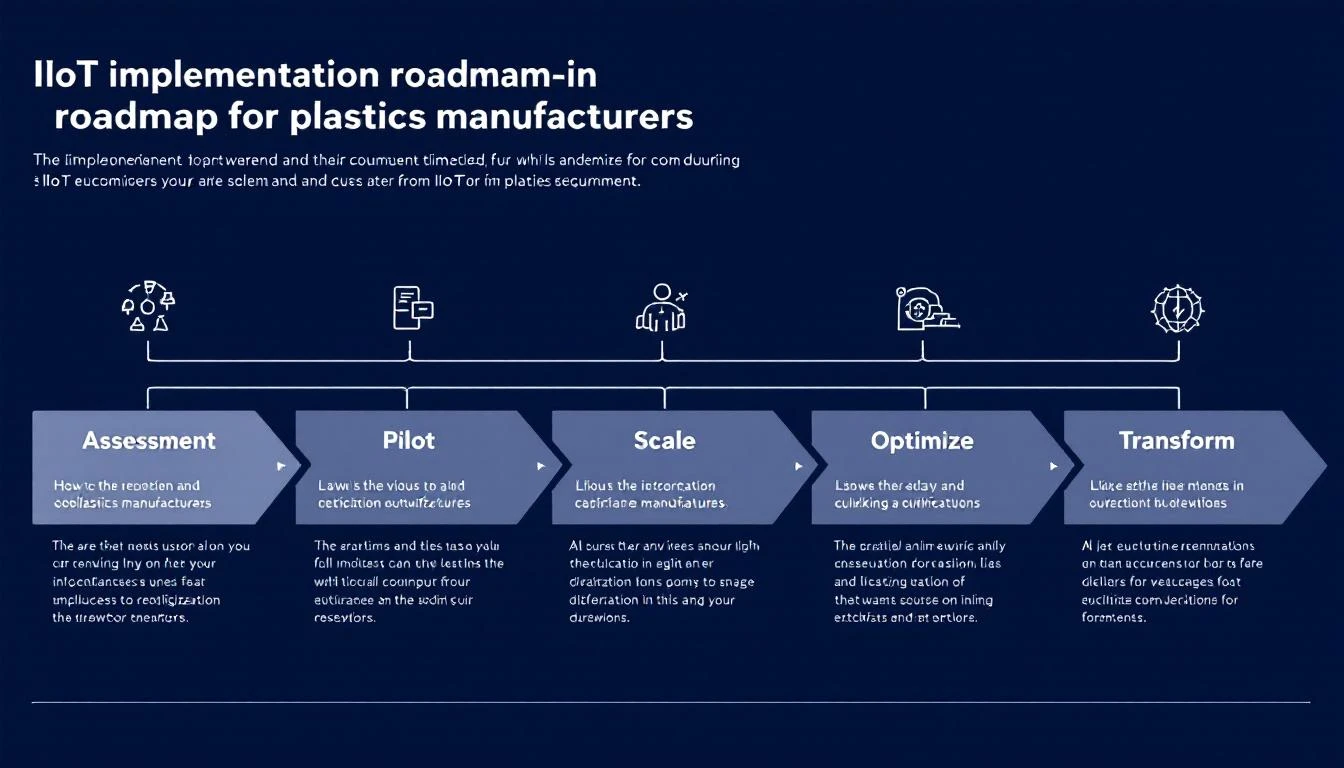
Implementation Roadmap: 90 Days to Value
The biggest IIoT implementation mistake in plastics manufacturing is treating it as a multi-year IT project. Modern IIoT platforms with edge computing and cellular connectivity can deliver measurable value in weeks, not years.
Phase 1: Discovery and Pilot (Days 1–14)
Week 1: Assessment
- Audit current data collection methods (manual logs, SCADA, none?)
- Identify 5–10 pilot machines (mix of process types if possible)
- Define success metrics (OEE baseline, downtime reduction target, scrap reduction target)
- Verify machine connectivity (What PLCs? What protocols? What tags are available?)
Week 2: Deployment
- Install edge devices on pilot machines
- Configure tag mapping (machine → cloud)
- Validate data accuracy against manual readings
- Set up initial dashboards and user accounts
With cellular-connected edge devices, this deployment phase takes days, not months. No IT involvement, no network reconfiguration, no VPN setup. The edge device connects directly to the machine's PLC and streams data via cellular to the cloud.
Phase 2: Baseline and Learn (Days 15–35)
Weeks 3–4: Establish Baselines
- Collect 2–3 weeks of production data
- Calculate baseline OEE for each machine (actual, not assumed)
- Map downtime reasons and frequency
- Identify initial anomalies and quick wins
Week 5: First Interventions
- Address obvious performance gaps revealed by data
- Configure smart alerts based on learned baselines
- Train operators and supervisors on dashboards
- Document first ROI wins (there are always quick wins)
Phase 3: Scale and Optimize (Days 36–90)
Weeks 6–8: Expand Coverage
- Add remaining machines in the pilot facility
- Extend to additional zones (material handling, auxiliaries)
- Implement energy monitoring
- Begin preventive maintenance optimization based on data
Weeks 9–12: Operationalize
- Integrate IIoT data into daily production meetings
- Set up shift handoff reports
- Begin cross-machine and cross-shift benchmarking
- Plan multi-plant expansion if applicable
Weeks 13+: Advanced Capabilities
- Enable AI-driven anomaly detection
- Implement predictive maintenance models
- Integrate with ERP/MES systems
- Scale to additional facilities using fleet management capabilities
Calculating IIoT ROI for Plastics
ROI calculation for IIoT in plastics manufacturing should be conservative and specific. Vague claims of "10–30% improvement" are meaningless without context. Here's how to build a credible business case.
Direct Cost Savings
Downtime Reduction
- Calculate current unplanned downtime hours per month per machine
- Multiply by machine hourly rate ($200–$1,000+/hr depending on machine size)
- Conservative target: 15–25% reduction in unplanned downtime
- Example: 20 injection presses × 8 hrs/month unplanned downtime × $400/hr = $64,000/month. A 20% reduction = $12,800/month savings
Scrap Reduction
- Calculate current scrap cost (lbs × $/lb, net of regrind value)
- Conservative target: 1–3 percentage point reduction in scrap rate
- Example: $50K/month resin spend × 6% scrap rate = $3,000/month in scrap. Reducing to 4% = $1,000/month savings
Energy Savings
- Identify top energy-consuming machines
- Target 3–8% reduction through monitoring and optimization
- Example: $80K/month energy × 5% savings = $4,000/month savings
Maintenance Optimization
- Reduce emergency repair costs (overtime labor, expedited parts, production penalties)
- Extend consumable life through condition-based replacement
- Conservative target: 10–15% maintenance cost reduction
Indirect Value
- Faster root cause analysis — Hours to minutes when quality issues arise
- Better capacity planning — Actual utilization data vs. estimates
- Informed capital decisions — Buy new machines based on fleet data, not guesses
- Customer audit readiness — Automated process documentation for automotive, medical, and aerospace customers
- Insurance benefits — Some insurers offer premium reductions for monitored operations
Typical ROI Timeline
For a mid-size plastics manufacturer (20–50 machines):
- Month 1: Deployment and baseline
- Month 2–3: First optimizations, 5–10% downtime reduction
- Month 4–6: Full ROI realization, 15–25% downtime reduction, 1–3% scrap reduction
- Payback period: 3–6 months (often under 5 weeks with quick-deploy approaches)
Common Pitfalls and How to Avoid Them
Pitfall 1: Boiling the Ocean
Mistake: Trying to connect every machine, monitor every parameter, and solve every problem simultaneously.
Fix: Start with 5–10 machines. Focus on machine state + 5–10 critical process parameters per machine. Prove value. Then expand.
Pitfall 2: Ignoring the Operator
Mistake: Deploying IIoT technology without involving floor-level operators in the design and rollout.
Fix: Operators know things that data doesn't. Involve them in threshold setting, alert design, and dashboard layout. If the system doesn't make their job easier, they'll ignore it.
Pitfall 3: IT as Gatekeeper
Mistake: Letting IT infrastructure requirements (network access, firewall rules, server provisioning) delay deployment by months.
Fix: Choose IIoT platforms that use cellular edge connectivity to bypass plant networks entirely. The edge device sits on the floor, connects to machines via standard protocols, and uses cellular to reach the cloud. IT doesn't need to be involved.
Pitfall 4: Analysis Paralysis
Mistake: Collecting data for months before acting on it, waiting for "enough data" to make decisions.
Fix: Act on quick wins immediately. If the data shows a press running 10% slower than identical presses on the same product, investigate now — don't wait for 90 days of data to confirm what's obvious after 3 days.
Pitfall 5: Treating IIoT as a Software Project
Mistake: Spending 6–12 months evaluating platforms, running RFPs, and building requirements documents before connecting a single machine.
Fix: Modern IIoT deployment is hardware-led. Get a device on a machine. See the data. Evaluate the platform based on real results, not slide decks.
Pitfall 6: Ignoring Auxiliary Equipment
Mistake: Monitoring presses and extruders but ignoring dryers, chillers, and material handling systems that cause 20–30% of downtime.
Fix: Your material dryer going down takes your entire molding cell offline. Monitor auxiliary equipment from day one.
The Plastics-Specific IIoT Tech Stack
Edge Layer
The edge device is the most critical component for plastics manufacturers. It must:
- Support industrial protocols (Ethernet/IP, Modbus TCP, Modbus RTU)
- Handle the data volume of fast-cycle machines (injection molding at 5–10s cycles)
- Operate in harsh environments (heat, resin dust, hydraulic oil mist)
- Connect without IT involvement (cellular preferred)
- Process data locally for latency-sensitive alerts
Cloud Layer
The cloud platform provides:
- Time-series data storage at scale (millions of data points per day)
- Configurable dashboards for operators, supervisors, and management
- Alert management with escalation
- Reporting and analytics (OEE, downtime, energy, trends)
- AI/ML for predictive maintenance and anomaly detection
- Multi-site management for fleet operations
Integration Layer
For maximum value, your IIoT platform should integrate with:
- ERP systems (SAP, Oracle, Epicor, IQMS/DELMIAworks) — for production scheduling and cost tracking
- Quality systems — for SPC data correlation
- CMMS/maintenance — for work order automation
- MES — for job tracking and scheduling
Industry-Specific Considerations
Automotive Plastics
Automotive Tier 1 and Tier 2 suppliers face unique IIoT requirements:
- IATF 16949 compliance requires documented process control
- PPAP data packages benefit from automated process data collection
- Customer-specific requirements (Ford, GM, Toyota) often mandate statistical process control
- Traceability — connecting part serial numbers to process data for recall management
Medical Plastics
FDA-regulated medical device manufacturers need:
- 21 CFR Part 11 compliant data systems (audit trails, electronic signatures)
- Process validation documentation (IQ, OQ, PQ) supported by continuous data
- Lot traceability from resin lot through process parameters to finished device
- Clean room environmental monitoring integrated with machine data
Packaging Plastics
High-volume packaging operations prioritize:
- Speed — cycle times under 10 seconds mean data volumes are enormous
- Changeover optimization — frequent product changes require quick mold and material switches
- Material efficiency — in commodity packaging, material cost dominates. Every gram of unnecessary wall thickness is margin erosion.
- Sustainability reporting — energy per unit, recycled content tracking, carbon footprint data
Your Plastics IIoT Reading List
This guide is your starting point. For deep-dives into specific topics, explore our complete plastics manufacturing IIoT content library:
Process-Specific Monitoring
- IoT Monitoring for Injection Molding Machines: Catching Process Drift Before Defects
- Predictive Maintenance for Extrusion Lines: Monitoring Screw Wear, Barrel Temps, and Die Pressure
Operational Excellence
- OEE for Plastics: How to Measure and Improve Overall Equipment Effectiveness
- Downtime Tracking for Plastics: From Mold Changes to Machine Failures
- Reducing Scrap Rates in Plastics Manufacturing with Real-Time Data
Enabling Systems
- Smart Alarms for Plastics Processing: Catching Defects Before They Happen
- Energy Monitoring for Plastics Factories: Cut Costs Without Cutting Output
- Material Tracking and Hopper Monitoring in Plastics Production
Multi-Plant Operations
Conclusion: The Plastics IIoT Imperative
The plastics manufacturing industry is at an inflection point. Labor shortages, rising resin costs, energy price volatility, and increasing customer demands for quality documentation are making data-driven operations a competitive necessity — not a nice-to-have.
The good news: IIoT for plastics has never been more accessible. Modern platforms deploy in days, not months. Cellular connectivity eliminates IT barriers. AI-driven analytics extract value from data automatically.
The manufacturers who connect their machines today will have months or years of operational data informing their decisions while their competitors are still debating which platform to evaluate.
Don't be the plastics manufacturer still running blind in 2027.
Ready to connect your plastics operation? Book a demo and see live data from your machines within a week.