Material Tracking and Hopper Monitoring in Plastics Production

In plastics manufacturing, your product is only as good as the material feeding it. A $500,000 injection molding press running $3/lb engineering resin can produce flawless parts — or expensive scrap — depending entirely on whether the right material, at the right moisture content, at the right blend ratio, arrives at the barrel at the right time.
Yet material management remains one of the least instrumented, most manually-dependent processes in the typical plastics factory. Operators check hopper levels by tapping on the side and listening. Dryer dewpoint gets verified once per shift — maybe. Regrind ratios are "about 20%" based on someone's best guess. And contamination? That gets caught when customers start rejecting parts.
The gap between how materials should be managed and how they actually are managed represents one of the largest hidden cost drivers in plastics processing — typically 3–8% of total material cost, which for a facility processing 5 million pounds of resin annually at $1.50/lb average, means $225,000–$600,000 per year in preventable waste.
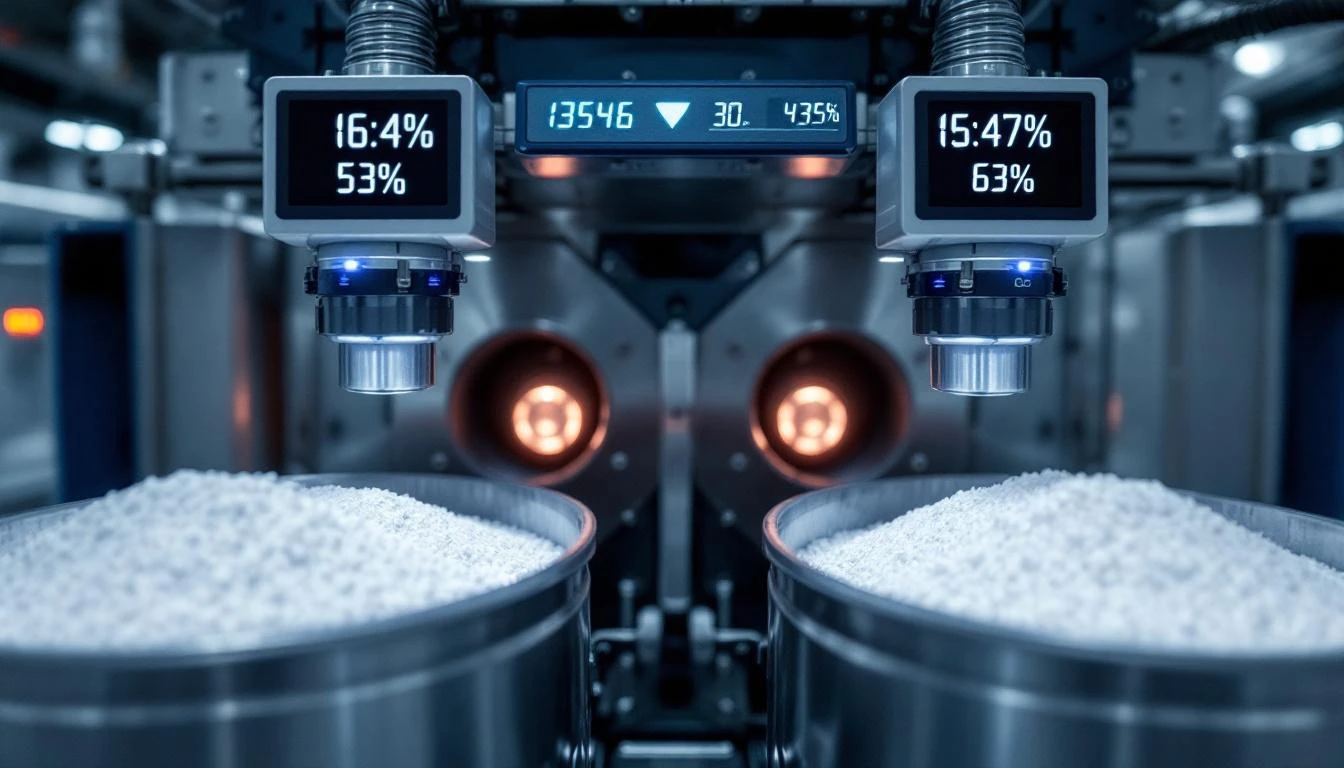
The Material Management Challenge in Plastics
Plastics manufacturing has a unique material management problem that other industries don't face. Unlike metal fabrication (where your raw stock sits on a shelf until you need it) or assembly operations (where components arrive pre-made), plastics processors must manage materials that are:
- Hygroscopic: Many engineering resins (nylon, polycarbonate, PET, ABS) absorb atmospheric moisture that must be removed before processing, or the parts will have splay marks, reduced mechanical properties, and cosmetic defects
- Time-sensitive: Dried material that sits too long re-absorbs moisture. Material in a hopper has a "dwell time" window before it's out of spec
- Blendable: Virgin resin is often mixed with regrind, colorant, additives, or other materials at precise ratios
- Contamination-prone: A few pellets of the wrong resin in a hopper can ruin an entire production run
- Expensive: Engineering resins like PEEK ($50+/lb), polycarbonate ($2.50/lb), or specialty nylons ($4–8/lb) make material waste financially painful
Manual management of these factors worked when plastics factories ran 5–10 machines with a handful of resins. Modern facilities running 30–80 machines with dozens of resin grades, colors, and formulations need systematic, instrumented material management.
Resin Inventory Management: Knowing What You Have
Effective resin inventory management starts before material ever reaches the production floor. Most plastics processors manage inventory through a combination of purchase orders, warehouse counts, and gut feel — a system that consistently produces two costly outcomes: running out of material mid-production and carrying excessive safety stock.
Real-Time Inventory Visibility
The foundation of modern resin inventory management is real-time visibility into three metrics:
On-hand quantity by grade: Not just "how many boxes of nylon are in the warehouse" but "how many pounds of PA6-GF30 black are available for production right now." This requires tracking material from receiving through drying through consumption.
Consumption rate by machine: Understanding that Press 12 running Tool A-4507 consumes 180 lbs/hour of PC/ABS tells you exactly how long your current inventory will last at the current production schedule. Without per-machine consumption tracking, you're guessing.
Lead time awareness: Resin supply chain disruptions have become more frequent since 2020. Knowing your average lead time by supplier and grade — and getting alerts when inventory drops below the lead-time-coverage threshold — prevents the emergency air-freight orders that cost 3–5x normal pricing.
MachineCDN's materials and inventory tracking capabilities provide this visibility automatically. As machines consume material, the platform tracks usage rates per machine and correlates them with inventory levels, giving plant managers a real-time view of material status across the facility without manual counting or spreadsheet reconciliation.
Lot Traceability
For processors serving automotive, medical, aerospace, or food-contact applications, lot traceability is non-negotiable. You need to know which lot of resin went into which parts, on which machine, during which shift. When a resin supplier issues a recall or a quality issue surfaces, the ability to trace affected parts in minutes instead of days determines whether you're pulling 500 parts or 50,000.
Digital material tracking creates this traceability chain automatically. Every hopper fill, every blend ratio, every lot changeover is recorded with timestamps, quantities, and machine assignments.
Hopper Level Monitoring: The Starvation Problem
Machine starvation — when a hopper runs empty and the screw starts pulling air instead of resin — is one of the most expensive preventable events in injection molding. A single starvation event can cause:
- Short shots: Incomplete parts that must be scrapped
- Air burns: Degraded material from processing air at melt temperature
- Screw damage: Running a screw without material causes metal-to-metal contact
- Color streaking: When the hopper refills, the transition zone produces off-color parts
- Production stoppage: While someone notices, refills the hopper, and purges the barrel
For a high-cavitation mold running a 15-second cycle, 10 minutes of starvation produces 40 cycles of scrap — potentially hundreds of parts worth thousands of dollars.
Continuous Level Monitoring
Modern hopper monitoring uses sensors to continuously track material level and generate alerts well before the hopper runs empty. The key metrics include:
Current level (percentage or weight): Real-time indication of how much material is in the hopper. This isn't just a "full/empty" binary — knowing whether a hopper is at 80% or 30% determines urgency and scheduling.
Consumption rate: How fast the level is dropping. A 200-lb hopper feeding a press running 180 lbs/hour will empty in roughly 67 minutes. If consumption rate increases (faster cycle, larger shot size), the alert threshold adjusts automatically.
Time-to-empty: The critical metric. By combining current level with consumption rate, the system calculates when the hopper will run out and alerts operators with enough lead time to refill without interrupting production.
Refill confirmation: Verifying that a hopper was actually refilled after an alert. Without this, "I'll get to it in a minute" can turn into machine starvation 20 minutes later.
Smart Alert Thresholds
Static "low level" alerts don't work well in plastics manufacturing because consumption rates vary dramatically between molds and materials. A 50% level alert makes sense on a small hopper feeding a fast-cycling machine but is unnecessarily early on a large hopper feeding a slow-cycling press.
Intelligent hopper monitoring calculates dynamic thresholds based on actual consumption patterns. The alert triggers when the estimated time-to-empty drops below a configurable window — typically 30–60 minutes, enough time for an operator or automated loading system to refill the hopper.
This is where IIoT platforms demonstrate their value over simple stand-alone sensors. When hopper monitoring is integrated with machine monitoring and production data, the system understands context: this hopper feeds this press running this mold at this cycle time, so the material consumption rate is X and the refill window is Y. Changes in any variable — a new mold, faster cycle, different material density — automatically adjust the monitoring parameters.
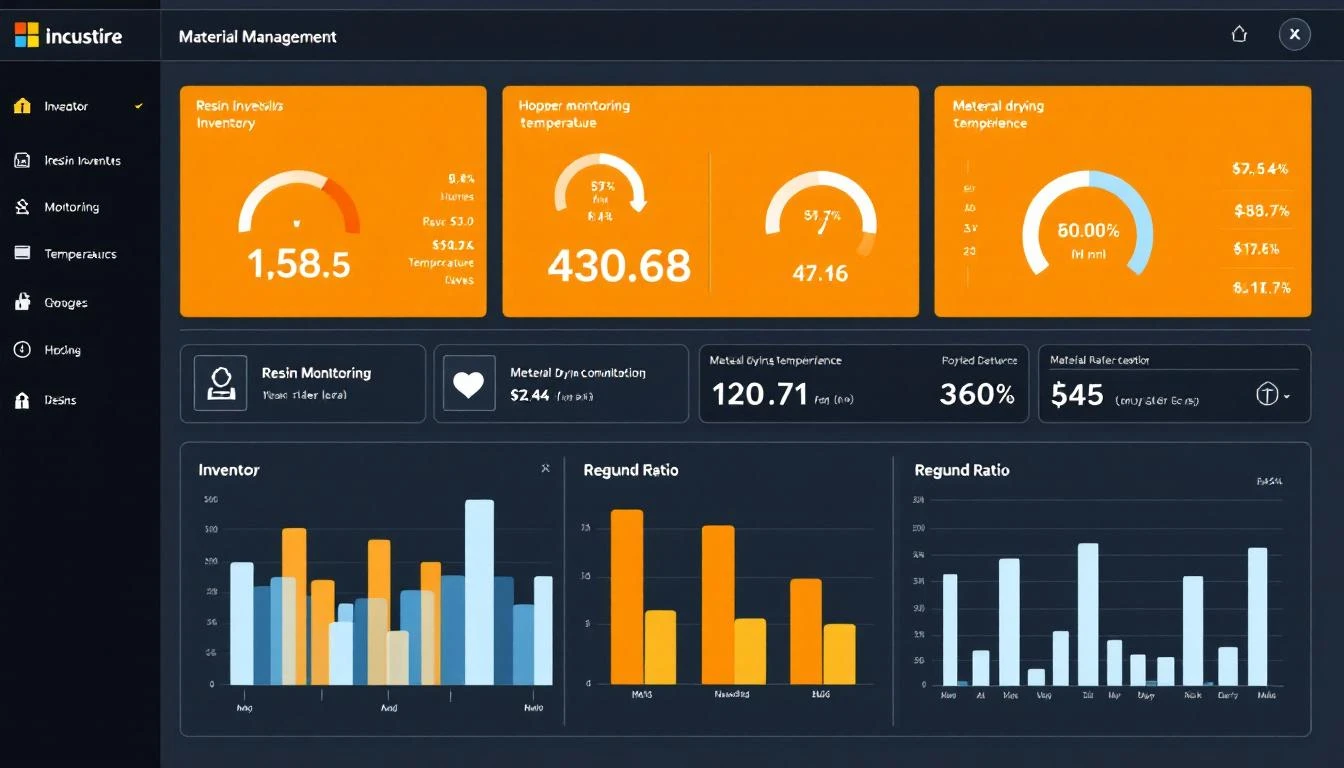
Material Drying Compliance: The Invisible Quality Killer
Moisture in resin is the single most common root cause of cosmetic and structural defects in injection-molded plastics parts. For hygroscopic materials, proper drying isn't optional — it's the difference between selling parts and scrapping them.
Why Moisture Matters
When hygroscopic resin absorbs moisture and enters the barrel at melt temperature, the water molecules cause hydrolysis — a chemical breakdown of the polymer chains. This produces:
- Splay marks: Silver streaks on the part surface from steam bubbles in the melt
- Reduced impact strength: Hydrolysis breaks polymer chains, reducing mechanical properties by 20–40%
- Brittleness: Parts that pass dimensional inspection but fail in service
- Bubbles and voids: Internal porosity that weakens structural parts
- Surface defects: Clouding, haze, and poor gloss on optical or cosmetic parts
The insidious thing about moisture-related defects is that they're not always visually obvious. A part can look perfect but have 30% less impact strength because the resin was 0.02% too wet. This is why specification-driven industries (automotive, medical) require documented proof of drying compliance.
Critical Drying Parameters
Every hygroscopic resin has a target moisture content and corresponding drying requirements:
| Resin | Max Moisture (%) | Drying Temp (°C) | Min Drying Time (hrs) |
|---|---|---|---|
| Nylon (PA6) | 0.10 | 80–85 | 4–6 |
| Polycarbonate (PC) | 0.02 | 120 | 3–4 |
| PET | 0.005 | 160–175 | 4–6 |
| ABS | 0.05 | 80 | 2–4 |
| PC/ABS | 0.02 | 100–110 | 3–4 |
| PEEK | 0.02 | 150 | 3 |
Monitoring these parameters requires tracking four variables continuously:
Dryer inlet temperature: Is the dryer actually reaching and maintaining the required temperature? Heater element degradation, thermocouple drift, or control system faults can cause the actual temperature to drift from setpoint.
Dewpoint: The moisture content of the drying air. A desiccant dryer should maintain -30°F to -40°F dewpoint. When desiccant beds degrade, dewpoint rises and drying effectiveness drops — sometimes without triggering a dryer alarm.
Drying time/residence time: Material must spend a minimum time in the dryer at temperature. If consumption rate increases (faster cycle, larger machine), material may pass through the dryer too quickly to reach spec. This is especially dangerous during production ramp-ups.
Material temperature at the press: The actual temperature of the resin when it enters the feed throat. If the material transport line is long or uninsulated, resin can cool and re-absorb moisture between the dryer and the press.
Automated Compliance Documentation
For processors serving regulated industries, drying compliance must be documented — not just maintained. This means continuous recording of dryer temperature, dewpoint, and throughput rate with timestamps that can be correlated to specific production lots.
Manual drying logs — a clipboard on the dryer where an operator records readings every 2–4 hours — are both unreliable and insufficient. An operator might record the reading 10 minutes late, miss a dewpoint excursion between checks, or simply transcribe the setpoint rather than the actual reading.
Automated drying compliance monitoring captures every data point continuously and flags deviations in real time. When a dewpoint excursion occurs at 2:47 AM and the operator doesn't notice until 6:00 AM, three hours of production may need to be quarantined and tested. With real-time alerting through a platform like MachineCDN, the excursion is flagged immediately, and corrective action can happen within minutes — limiting scrap to a single hopper of material rather than an entire shift's production.
Regrind Management: The Profit in Your Scrap
Every injection molding operation generates runners, sprues, and reject parts that can be reground and reprocessed. Effective regrind management is a significant profit lever — but only when ratios are controlled and quality is maintained.
Why Regrind Ratios Matter
Regrind is resin that has been through the melt-and-cool cycle once already. Each heat history degrades the polymer slightly:
- Molecular weight decreases: Shorter polymer chains mean reduced mechanical properties
- Color shifts: Heat history causes yellowing or color drift, especially in light-colored parts
- Flow characteristics change: Degraded material flows differently, potentially affecting fill patterns and part dimensions
- Contamination accumulates: Each regrind pass can introduce dust, fines, metal particles, or cross-contaminated material
Most resin manufacturers specify maximum regrind ratios — typically 15–30% for engineering resins and up to 100% for some commodity materials. Exceeding these ratios risks part failures, customer rejections, and warranty claims.
Monitoring Regrind Ratios in Real Time
The traditional approach to regrind management is... there isn't one. Someone sets the blender to "about 25%" regrind, and nobody verifies it. The actual ratio drifts based on regrind particle size (finer particles fall through faster), hopper level (ratio changes as hopper empties), and operator attention.
Proper regrind monitoring tracks:
Actual blend ratio: Weighing virgin and regrind inputs to confirm the target ratio is being maintained. Gravimetric blenders do this by design, but many facilities still use volumetric blending where the ratio is approximate at best.
Regrind generation rate: How much regrind is being produced per shift, per machine. If a machine suddenly starts generating 40% regrind (vs. its normal 15%), something has changed — likely a quality issue producing more scrap.
Regrind inventory: How much regrind of each grade/color is available. Excess regrind sitting in bins for weeks degrades from moisture absorption and dust contamination. Regrind should be used within 24–48 hours of generation.
Heat history tracking: Ideally, regrind should be limited to a single regrind pass. Material that's been reground multiple times has compounding degradation. Without tracking, multi-generation regrind can silently degrade part quality.
By integrating regrind tracking with production monitoring, platforms like MachineCDN enable correlation between regrind ratio changes and scrap rate variations. If scrap rates increase when regrind ratio exceeds 20%, that's a data-driven limit — not a guess.
The Economics of Regrind
Consider a facility processing 2 million pounds of polycarbonate annually at $2.50/lb. If proper regrind management increases the effective regrind ratio from 15% to 25% (while maintaining quality), that's an additional 200,000 lbs of regrind displacing virgin resin — saving $500,000 per year in material cost.
Conversely, poor regrind management that causes a 2% increase in scrap rate costs 40,000 lbs of material — $100,000 per year — plus the labor and machine time to produce those scrapped parts.
The difference between good and bad regrind management can easily swing $600,000 annually for a mid-size facility. Yet most processors manage it with guesswork.
Contamination Prevention: Keeping the Wrong Pellets Out
Material contamination is the nightmare scenario for any plastics processor. A handful of incompatible pellets in a hopper can cause:
- Complete production run rejection: Even a few contaminated parts in a batch can trigger rejection of the entire lot
- Tool damage: Materials with dramatically different melt temperatures can damage mold surfaces or hot runner systems
- Property failures: Small amounts of the wrong material can reduce impact strength, chemical resistance, or flame retardancy below specification
- Costly purging: Clearing contaminated material from a barrel and hot runner can take 1–3 hours and consume 50–200 lbs of purge compound
Common Contamination Sources
Material changeovers are the highest-risk event. When switching from one resin to another on the same machine, residual material in the hopper, loader, drying system, and feed throat can contaminate the new material. Proper changeover procedures include purging, cleaning all transfer lines, and running initial shots until the new material runs clean.
Shared drying systems create cross-contamination risk when multiple materials are dried in adjacent hoppers or on the same desiccant air manifold. Pellet dust from one material can migrate to adjacent hoppers.
Regrind cross-contamination happens when the same granulator is used for multiple materials without thorough cleaning between runs. Residual pellets from the previous material end up blended into the next.
Mislabeled containers are more common than anyone likes to admit. A bin labeled "PC Natural" that actually contains PC/ABS, or a gaylord of nylon 6 that got mixed with nylon 66, can propagate through an entire shift before anyone notices.
Digital Safeguards Against Contamination
Material tracking systems create digital barriers against contamination:
Machine-material assignment verification: The system knows which material should be feeding each machine based on the current production schedule. If someone attempts to load the wrong material, the system flags the mismatch before it reaches the barrel.
Changeover checklists: Digital changeover procedures ensure every step — purging, line cleaning, dryer swap, first-article inspection — is completed and documented before production resumes. No checkboxes means no production start.
Lot-to-machine tracking: Every material movement is logged with lot number, source, destination machine, and timestamp. If contamination is later discovered, the tracking data identifies exactly which lots and machines are affected — enabling surgical quarantine rather than shotgun scrapping.
Connecting material tracking to predictive maintenance systems amplifies both capabilities: unusual barrel pressure or screw torque readings during a changeover can indicate incomplete purging, catching contamination before it produces defective parts.
Integrating Material Tracking Across the Facility
The real power of material tracking emerges when it connects to the broader production monitoring ecosystem. Isolated hopper sensors or standalone dryer monitors provide limited value compared to an integrated platform that correlates material data with machine performance, quality, and energy consumption.
Material-to-Quality Correlation
When material tracking data links to production quality data, patterns emerge that manual systems can never detect:
- "Scrap rate increases 35% when we use Supplier B's nylon vs. Supplier A's" → negotiate or switch suppliers
- "Parts from Press 7 fail impact testing when regrind exceeds 18%" → lower the regrind limit on that specific machine
- "Dimensional variation increases when dryer dewpoint exceeds -25°F" → tighten dewpoint alarm threshold
These correlations are invisible without integrated data. The insights from connecting material tracking with OEE monitoring can drive quality improvements that reduce scrap by 30–50%.
Material-to-Energy Correlation
Material condition directly impacts energy consumption. Wet resin requires more barrel heating energy (the water absorbs heat during evaporation). Regrind with different flow characteristics may require higher injection pressures. These energy impacts are only visible when material tracking and energy monitoring data are correlated.
Demand-Driven Material Planning
When the material tracking system knows current consumption rates, current inventory levels, and the upcoming production schedule, it can generate demand-driven replenishment signals — replacing the guesswork of traditional reorder-point inventory management.
Instead of carrying two weeks of safety stock across all grades, the system calculates required quantities based on the actual production schedule and current consumption rates, potentially reducing working capital tied up in resin inventory by 20–40% while simultaneously reducing stockout risk.
Implementation: Starting Simple, Scaling Smart
Material tracking in plastics doesn't require a massive capital investment or a six-month implementation project. The pragmatic approach:
Week 1–2: Hopper monitoring on critical machines. Start with the 5–10 machines running the highest-value or most moisture-sensitive materials. Install level monitoring and set up starvation alerts. MachineCDN's plug-and-play approach means a device can be connected and reporting material data in minutes — no IT infrastructure changes, no network integration, no weeks of configuration.
Week 3–4: Dryer monitoring integration. Connect dryer temperature and dewpoint data to the same platform. Configure compliance alerts for temperature excursions and dewpoint drift.
Month 2: Regrind tracking. Implement gravimetric blending verification on key machines. Begin tracking regrind generation rates and correlating with scrap data.
Month 3+: Full integration. Connect material tracking with production monitoring, quality data, and energy data. Begin generating the correlations that drive continuous improvement.
The facilities that implement this roadmap typically see 2–5% material cost reduction within the first quarter — which for a facility spending $7–10M annually on resin translates to $140,000–$500,000 in savings.
The Bottom Line
Material management in plastics manufacturing has been manual for too long. In an industry where raw material is both the largest cost and the primary determinant of part quality, managing it with clipboards, gut feel, and "tap the hopper" is a business risk disguised as standard practice.
Digital material tracking — from resin receiving through drying through blending through consumption — transforms material management from a source of variability into a controlled, optimized process. Hopper monitoring prevents starvation. Drying compliance prevents moisture defects. Regrind tracking maximizes material utilization while protecting quality. Contamination prevention protects against catastrophic scrap events.
The data is there. The sensors are affordable. The platforms are ready. The only remaining question is how much longer you'll manage your most expensive input by guesswork.
Ready to get visibility into your material flow? Book a demo and see how MachineCDN tracks materials from hopper to finished part — with setup in minutes, not months.