Smart Alarms for Plastics Processing: Catching Defects Before They Happen

A short shot costs you a part. A flash defect costs you a part and a mold repair. A hydraulic blowout costs you a shift. But the data that predicted every one of these failures was sitting in your PLC registers 30 minutes before they happened — barrel zone 3 creeping 8°F above setpoint, hydraulic pressure trending 200 PSI below normal, cooling water flow dropping 15% from baseline.
The difference between catching a defect and shipping a defect is whether your monitoring system screams at the right time. Smart alarms for plastics processing aren't just about knowing when something broke — they're about knowing when something is about to break.
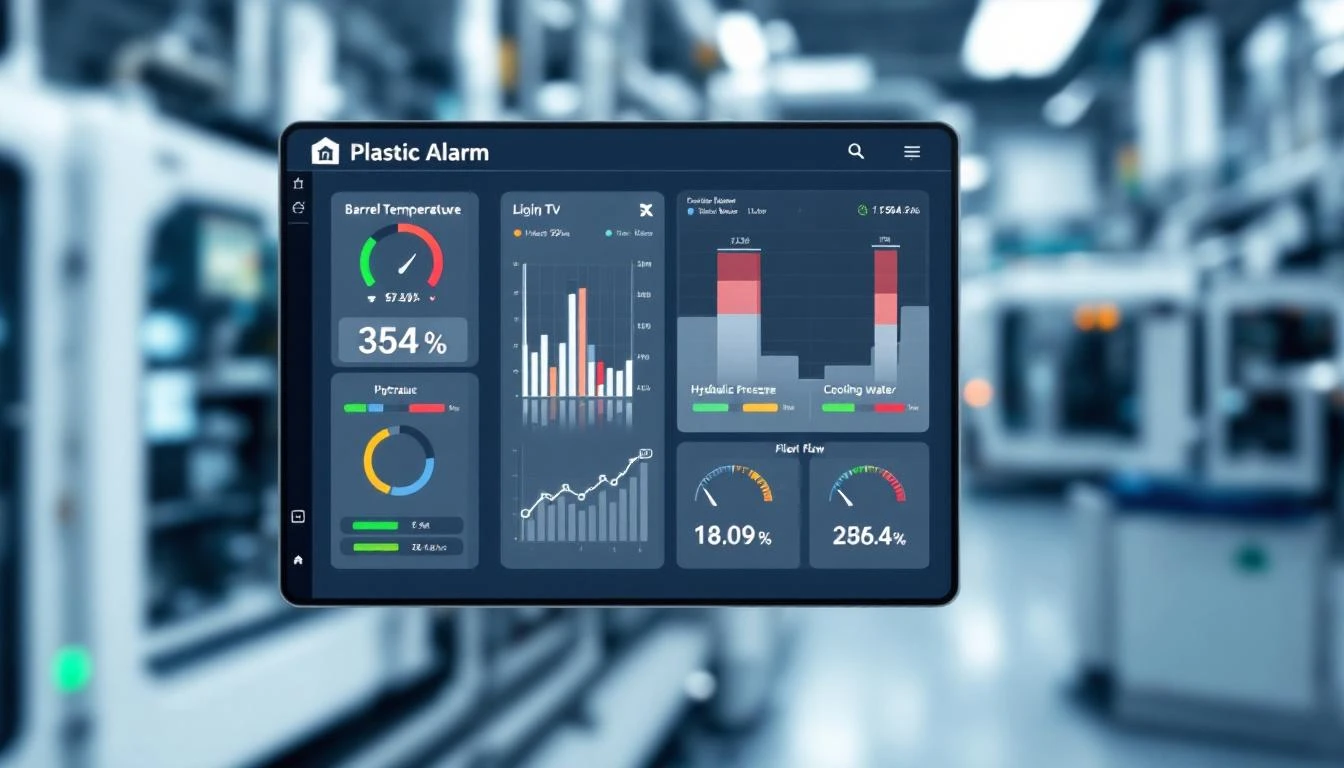
Why Traditional Alarms Fail in Plastics Manufacturing
Most injection molding machines and extruders ship with built-in alarms. The press controller will fault when barrel temperature exceeds a hard limit, when clamp pressure drops below minimum, or when cycle time exceeds a maximum timeout. These are safety alarms — they prevent catastrophic damage to the machine.
But they're terrible at preventing quality issues.
By the time a machine-level alarm triggers, you've already produced dozens (sometimes hundreds) of defective parts. The barrel temperature didn't jump 50°F in one cycle — it drifted 2°F per cycle over 25 cycles until it crossed the machine's generous fault threshold. During that entire drift, your parts were getting progressively worse: sink marks deepening, warp increasing, dimensional tolerance drifting out of spec.
The fundamental problem: Machine alarms protect the machine. Smart alarms protect the product.
A modern IIoT alarm system does three things that machine-level alarms cannot:
- Tighter thresholds — Set process windows based on quality requirements, not machine safety limits
- Trend detection — Alert on drift patterns, not just absolute values
- Multi-variable correlation — Detect when the combination of parameters indicates trouble, even if no single variable has crossed a threshold
Critical Parameters to Monitor in Injection Molding
Injection molding is a multi-variable process where barrel temperatures, pressures, speeds, and times must stay within tight windows to produce consistent parts. Here are the parameters that benefit most from smart alarming:
Barrel Temperature Zones
Every injection molding barrel is divided into 3-6 heating zones, each with its own heater band and thermocouple. Typical temperature control bands on the machine controller are ±10°F — far too wide for precision molding.
Smart alarm thresholds for barrel temperatures:
| Parameter | Approaching Alarm | Active Alarm |
|---|---|---|
| Zone deviation from setpoint | ±5°F | ±10°F |
| Zone-to-zone gradient change | >3°F shift | >7°F shift |
| Time to reach setpoint (cold start) | >15% longer than baseline | >30% longer than baseline |
| Temperature oscillation amplitude | >3°F swing | >6°F swing |
Why the "approaching" state matters: When zone 3 is 5°F above setpoint, you're not producing scrap yet — but you will be in 20 minutes if the trend continues. The approaching alarm gives the operator or maintenance tech time to investigate before quality is impacted.
A zone that's taking progressively longer to reach setpoint after a cold start is a leading indicator of heater band degradation. By the time the heater fails completely, you've had days or weeks of warning through the approaching alarm state. This is exactly the kind of early detection we cover in IoT monitoring for injection molding machines.
Hydraulic Pressure
Hydraulic injection molding machines rely on stable system pressure for consistent clamp force, injection speed, and pack/hold pressure. Even small hydraulic pressure variations cascade into part quality issues:
- Low clamp pressure → Flash at the parting line
- Inconsistent injection pressure → Short shots, flow marks, weld line weakness
- Pack pressure variation → Sink marks, dimensional inconsistency, weight variation
Smart alarm thresholds for hydraulic systems:
| Parameter | Approaching Alarm | Active Alarm |
|---|---|---|
| System pressure deviation | ±50 PSI from baseline | ±150 PSI from baseline |
| Pressure drop rate (per hour) | >25 PSI/hr decline | >75 PSI/hr decline |
| Accumulator pre-charge pressure | <90% of spec | <80% of spec |
| Oil temperature | >130°F | >150°F |
The pressure drop rate alarm is critical. A slow, steady decline in system pressure typically indicates a seal leak, pump wear, or oil bypass — all conditions that worsen over time. By the time the absolute pressure threshold triggers, you may have produced hours of marginal parts.
Connecting hydraulic monitoring to your IIoT platform also lets you correlate pressure trends with specific molds. If system pressure only drops during a particular high-tonnage mold, you might have a clamp tonnage issue rather than a hydraulic problem.
Cycle Time Deviations
Cycle time is the heartbeat of an injection molding operation. Every cycle should be nearly identical — the same fill time, pack time, cooling time, and mold open/close time. When cycle times start varying, something has changed.
| Parameter | Approaching Alarm | Active Alarm |
|---|---|---|
| Total cycle time deviation | ±3% from standard | ±7% from standard |
| Fill time variation | ±0.2 seconds | ±0.5 seconds |
| Recovery time increase | >5% above baseline | >15% above baseline |
| Mold open time variation | >1 second deviation | >3 seconds deviation |
Recovery time deserves special attention. Screw recovery (plasticating) time is a direct indicator of material viscosity, screw condition, and barrel temperature stability. If recovery time is creeping up, potential causes include:
- Screw or check ring wear reducing plasticating efficiency
- Material moisture content issues (especially with hygroscopic resins like nylon and PC)
- Barrel temperature zone running low
- Material lot-to-lot viscosity variation
An IIoT platform that tracks recovery time trend over days and weeks gives you predictive maintenance intelligence that no machine controller can provide on its own. This feeds directly into understanding your OEE in plastics manufacturing — cycle time variation is a performance loss that silently erodes your throughput.
Critical Parameters to Monitor in Extrusion
Extrusion is a continuous process, which makes alarm management both simpler (fewer start/stop transitions) and more critical (an undetected drift can produce thousands of feet of out-of-spec product).
Melt Temperature and Pressure
The melt temperature at the die and the melt pressure at the breaker plate are the two most important quality indicators in extrusion.
| Parameter | Approaching Alarm | Active Alarm |
|---|---|---|
| Melt temperature deviation | ±5°F from setpoint | ±12°F from setpoint |
| Die pressure deviation | ±50 PSI | ±150 PSI |
| Pressure ratio (die/barrel) | >10% change | >25% change |
| Melt temperature ramp rate | >2°F/min change | >5°F/min change |
The pressure ratio alarm catches issues that absolute pressure alarms miss. If both die pressure and barrel pressure are rising proportionally, the extruder may simply be ramping up. But if die pressure is rising while barrel pressure stays flat, you likely have a screen pack clogging or die buildup — a condition that leads to quality issues and potential pressure safety events.
For a deeper dive into extrusion-specific monitoring, see our guide on predictive maintenance for extrusion lines.
Drive Motor Current (Amps)
Extruder screw drive motor current is a proxy for screw load, material viscosity, and overall system health. Smart thresholds include:
| Parameter | Approaching Alarm | Active Alarm |
|---|---|---|
| Motor current vs. baseline | ±8% deviation | ±15% deviation |
| Current surge frequency | >3 surges/hour | >8 surges/hour |
| Current trend (over 24hr) | >5% upward trend | >10% upward trend |
A gradual upward trend in motor amps at constant RPM indicates increased resistance — typically from screw/barrel wear, material bridging in the feed throat, or contamination. This is one of the most reliable early indicators of mechanical wear in extrusion.
Cooling Water Flow
Cooling is often the forgotten variable in plastics processing, yet it directly controls part quality in both injection molding and extrusion:
- Injection molding: Mold cooling accounts for 60-80% of total cycle time. Inconsistent cooling water flow creates hot spots, warpage, and dimensional variation.
- Extrusion: Cooling tanks, spray bars, and sizing sleeves require consistent water flow and temperature to maintain dimensional stability.
| Parameter | Approaching Alarm | Active Alarm |
|---|---|---|
| Flow rate deviation | ±10% from baseline | ±25% from baseline |
| Supply water temperature | ±3°F from setpoint | ±8°F from setpoint |
| Delta-T (supply vs. return) | >20% change from baseline | >40% change from baseline |
| Flow imbalance (circuit-to-circuit) | >15% variation | >30% variation |
The delta-T alarm is particularly powerful for injection molding. The temperature difference between cooling water supply and return tells you how much heat the mold is actually absorbing. If delta-T suddenly increases, the mold is running hotter than expected — potentially indicating a clogged cooling channel, a malfunctioning temperature controller, or a process change that's adding more heat to the mold.
Flow imbalance alarms catch situations where one cooling circuit is partially blocked while others run normally. The machine keeps running, but one area of the mold cools slower, creating localized warpage, sink marks, or extended cycle time.
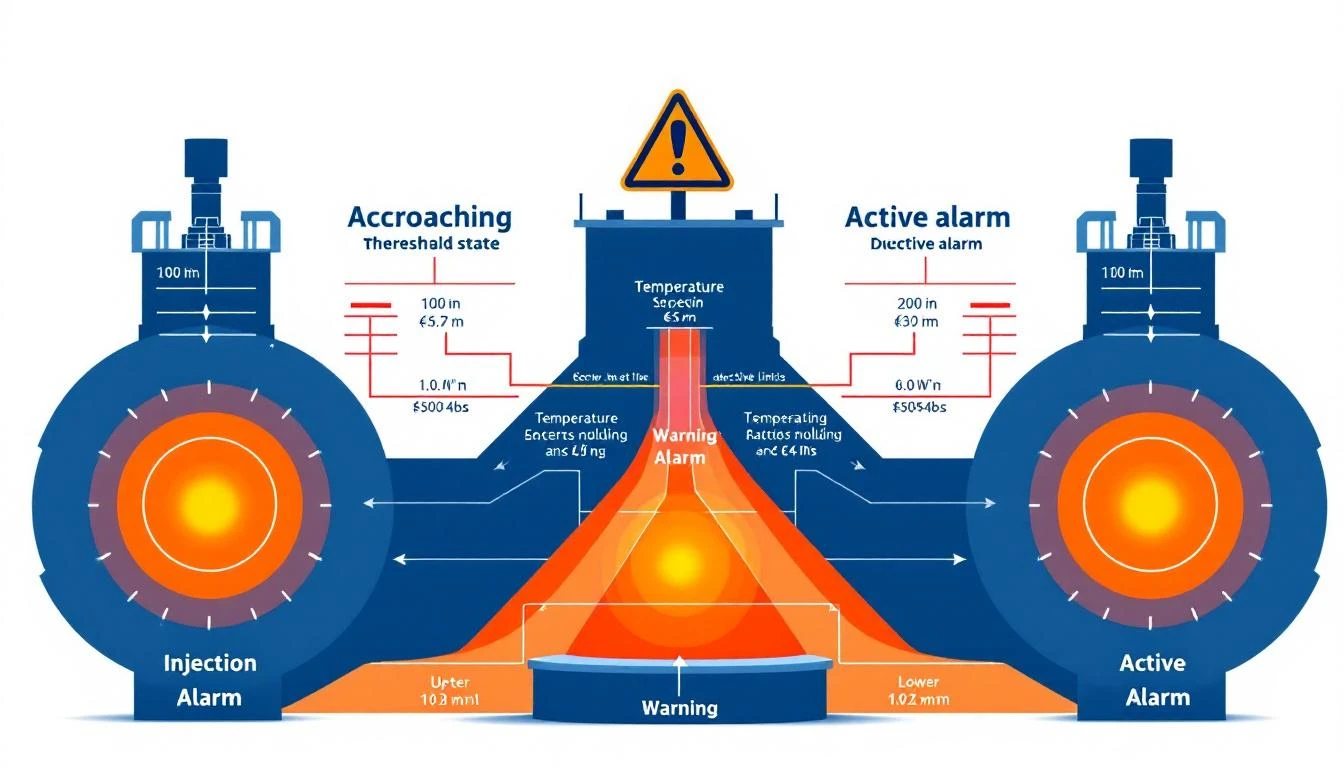
Active vs. Approaching Alarms: The Two-Tier System
The most effective alarm management strategy for plastics processing uses a two-tier threshold system:
Approaching (Warning) State:
- Parameter has drifted outside the optimal process window but is still within acceptable limits
- Production quality may still be acceptable, but the trend indicates trouble
- Triggers a notification to the operator or supervisor
- Provides a window to investigate and correct before quality is impacted
- Typically color-coded yellow on monitoring dashboards
Active (Critical) State:
- Parameter has crossed the threshold where quality impact is likely or confirmed
- Immediate action required — inspect parts, investigate root cause, potentially stop production
- Triggers escalated notification (supervisor, maintenance, quality)
- Logged for root cause analysis and corrective action tracking
- Color-coded red on monitoring dashboards
The power of this two-tier system is the time buffer between approaching and active states. In traditional alarm systems, you get zero warning — the alarm fires when the problem is already impacting quality. With approaching alarms, you might get 15-30 minutes of warning before the condition becomes critical.
Setting Effective Threshold Widths
The gap between approaching and active thresholds should be calibrated based on:
-
Process sensitivity — How much parameter variation does this material/part tolerate? Medical-grade components need tighter bands than commodity packaging.
-
Drift rate — How quickly does this parameter typically change? Barrel temperatures drift slowly (minutes to hours); hydraulic pressure failures can cascade rapidly (seconds to minutes).
-
Response time — How long does it take your team to respond to an alert? If your technician needs 10 minutes to reach the press, the approaching threshold needs to fire at least 10 minutes before quality impact.
-
False alarm tolerance — Thresholds set too tight create alarm fatigue. Operators who see 50 approaching alarms per shift start ignoring them all. Target fewer than 5 approaching alarms per shift per machine during stable production.
Alarm Management Best Practices for Plastics Plants
1. Establish Baselines Before Setting Thresholds
Don't guess at threshold values. Run your process with known good quality for at least one full production cycle (ideally 48-72 hours of steady-state operation). Record the natural variation in every monitored parameter. Set your approaching threshold at 2x the natural variation and your active threshold at 4x.
Example: If barrel zone 2 naturally varies ±2°F during stable production, set the approaching alarm at ±4°F and the active alarm at ±8°F.
2. Use Material-Specific Alarm Profiles
Different resins have dramatically different processing windows. ABS is relatively forgiving — ±15°F in barrel temperature might not produce visible defects. Nylon 6/6 with 33% glass fill has a processing window of maybe ±5°F before you see splay, burn marks, or degradation.
Your alarm system should support alarm profiles tied to material types or specific jobs. When the operator starts a new job running PEEK instead of polypropylene, the alarm thresholds should automatically tighten to reflect the material's narrower process window.
3. Implement Alarm Escalation Paths
Not all alarms deserve the same response:
- Approaching alarm on a non-critical parameter → Operator notification (dashboard highlight)
- Approaching alarm on a critical parameter → Operator + supervisor notification
- Active alarm on any parameter → Operator + maintenance + quality notification
- Multiple active alarms simultaneously → Production hold + management notification
MachineCDN's alarm management system supports configurable escalation paths with different notification channels — dashboard alerts for operators, push notifications for supervisors, and automated escalation for critical multi-alarm situations.
4. Track Alarm Frequency as a Health Metric
The number of alarms per shift should be a tracked KPI. An increasing alarm frequency — even if no single alarm seems critical — often indicates systemic drift:
- Process parameters slowly migrating away from optimal
- Equipment wearing toward the edge of its capability
- Material quality declining lot-to-lot
- Environmental conditions (ambient temperature, humidity) shifting seasonally
When you see alarm frequency rising, it's time for a comprehensive process review before the individual alarms compound into an actual quality event. This alarm-as-leading-indicator approach is a core principle in equipment health monitoring.
5. Conduct Regular Alarm Rationalization
Every 90 days, review your alarm configuration:
- Which alarms fire most frequently? Are they actionable, or are the thresholds too tight?
- Which alarms never fire? Are the thresholds too loose, or is the parameter genuinely stable?
- Which alarms led to corrective actions? These are your most valuable alarms — protect them.
- Which alarms do operators routinely acknowledge without investigating? These are alarm fatigue generators — either widen the threshold or remove the alarm.
The goal is a lean alarm set where every alarm triggers a meaningful response. In plastics processing, a well-tuned plant typically runs with 20-30 active alarm points per machine — enough to catch real issues without overwhelming the operator.
Multi-Variable Alarms: The Next Level
Single-variable alarms catch most issues, but the most insidious quality problems in plastics processing involve multiple parameters shifting simultaneously in ways that no single alarm catches.
Examples:
- Barrel temperature rising + recovery time decreasing = Material degradation (thermal history too high)
- Cycle time stable + cushion increasing = Check ring wear (material leaking past the check ring during hold)
- Hydraulic pressure stable + clamp tonnage dropping = Toggle wear (pressure is fine, but mechanical linkage is worn)
- Cooling water flow stable + delta-T increasing = Mold fouling (flow rate is maintained but heat transfer is degrading)
Advanced IIoT platforms can implement correlation alarms that watch parameter relationships rather than individual values. This is where plastics processing monitoring moves from reactive (catching problems) to predictive (anticipating problems).
Getting Started: A Practical Alarm Implementation Roadmap
Week 1-2: Instrument and Baseline Connect your critical machines to an IIoT platform. MachineCDN connects to injection molding machines and extruders in minutes — reading process data directly from the machine controller without additional sensors. Let the system collect baseline data across all parameters.
Week 3-4: Set Initial Thresholds Using baseline data, set conservative (wide) approaching and active thresholds for your top 10 parameters per machine. Start with barrel temperatures, hydraulic pressure, cycle time, and cooling water flow.
Month 2: Refine and Tighten Review alarm history. Tighten thresholds on parameters that were too loose. Widen thresholds on parameters generating false alarms. Add material-specific profiles for your most-run materials.
Month 3: Expand and Correlate Add alarms for secondary parameters (motor amps, mold temperature, specific material parameters). Begin implementing multi-variable correlation alarms for known failure patterns.
Ongoing: Rationalize and Optimize Quarterly alarm reviews. Track alarm frequency trends. Correlate alarm events with actual quality data (scrap rate, customer complaints) to validate that your alarms are catching the right things.
The plastics manufacturers who implement this phased approach consistently report catching process drift 4-8 hours earlier than with machine-level alarms alone. For a shop running 20 presses at $10,000/hour throughput value, catching a drift event even 2 hours earlier saves $20,000+ per incident — and most shops experience multiple drift events per month.
For a complete picture of how alarm monitoring integrates with broader process optimization, explore our guides on reducing scrap rates in plastics manufacturing and downtime tracking for plastics.
Ready to implement smart alarms for your plastics operation? MachineCDN's threshold alerting system connects to your injection molding machines and extruders in minutes — with configurable approaching and active alarm states, escalation paths, and fleet-wide alarm analytics. No sensors to install, no IT involvement required.