IIoT for Food and Beverage Manufacturing: A Practical Guide to Protecting Quality, Compliance, and Uptime

Food and beverage manufacturing operates under constraints that most other industries don't face. Your products expire. Your regulators show up unannounced. Your equipment touches what people eat. And when a production line goes down during a seasonal peak, the raw materials waiting in your cooler don't politely pause their biological clocks.
These constraints make food and beverage one of the most compelling use cases for industrial IoT — and one of the most underserved. Most IIoT platforms were built for automotive, aerospace, or heavy industry. They don't understand changeover frequencies, CIP cycles, cold chain requirements, or why a 2°F temperature deviation at 3 AM matters more than a 20°F deviation in a metal stamping plant.
This guide breaks down how IIoT specifically helps food and beverage manufacturers address their unique challenges — not in theory, but in the practical, measurable ways that justify the investment.

Why Food & Beverage Is Different
Before diving into IIoT applications, let's acknowledge what makes F&B manufacturing uniquely challenging:
1. Regulatory pressure is constant. FSMA (Food Safety Modernization Act), HACCP, SQF, BRC, FDA 21 CFR Part 117 — the alphabet soup of food safety regulations requires continuous monitoring, documentation, and traceability. A single compliance failure can shut down a line, trigger a recall, or end a customer relationship.
2. Product perishability drives urgency. Unplanned downtime in food manufacturing isn't just lost production — it's spoiled raw materials, wasted processing time, and potentially contaminated product that has to be destroyed. The cost of downtime includes both lost production AND lost materials. Industry estimates put the average cost of unplanned downtime in food manufacturing at $30,000-$50,000 per hour, including material waste.
3. Changeovers are frequent. Unlike automotive plants that run the same part for weeks, food manufacturers switch between products, flavors, and packaging formats multiple times per shift. Each changeover is a window for quality issues, contamination, and lost production time.
4. Cleaning requirements consume capacity. CIP (Clean-In-Place) cycles, sanitation protocols, and allergen changeovers can consume 15-25% of available production time. Optimizing cleaning frequency without compromising food safety requires data that most plants don't have.
5. Supply chain variability affects production. Ingredient variability (moisture content, protein levels, fat percentages) directly impacts process parameters. A batch of flour with 12% moisture behaves differently than one with 14%. Without real-time process monitoring, operators make adjustments by experience — which works until it doesn't.
Five IIoT Applications That Deliver Measurable ROI
1. Continuous Temperature and Process Monitoring
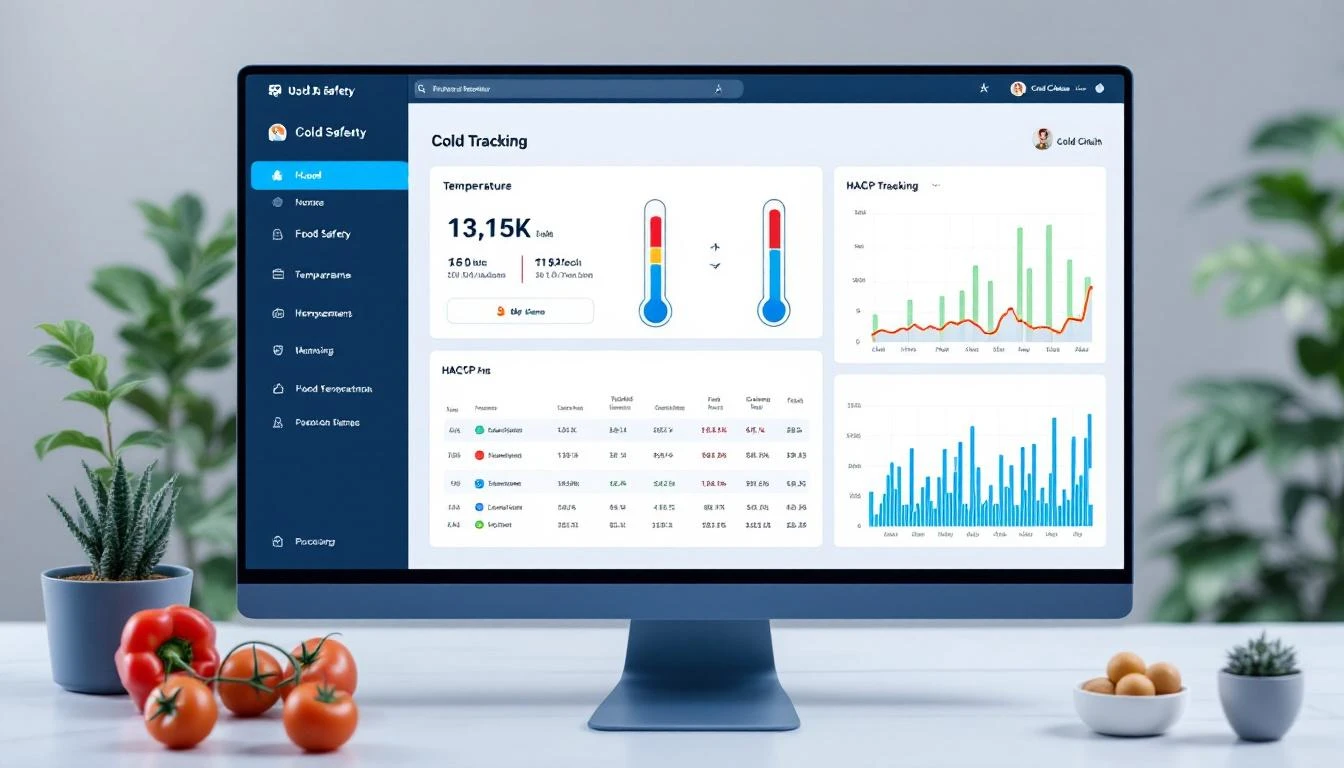
The problem: HACCP requires temperature monitoring at critical control points (CCPs). Most plants still use manual temperature checks — a technician walks around with a probe thermometer, checks temperatures at defined intervals (typically every 2-4 hours), and logs the reading on paper or a tablet.
Between those checks, anything could happen. A cooler compressor could fail at 2 AM. A pasteurizer could drift out of spec between shift changes. A blast freezer could struggle under an unusually heavy load. You don't know until the next manual check — or until product fails the quality test.
The IIoT solution: Connect PLCs that control temperature-critical equipment to a real-time monitoring platform. Instead of 6-12 manual checks per day, you get continuous monitoring with configurable threshold alerts.
Imagine alerts like:
- "Cooler 3 temperature has risen 3°F in the last hour — approaching CCP threshold"
- "Pasteurizer hold tube temperature dropped below 161°F for 12 seconds at 4:23 AM"
- "Blast freezer core temperature is taking 15% longer to reach target than baseline"
The first alert prevents a food safety event. The second documents one for investigation. The third signals a maintenance issue before it becomes a food safety issue.
Measurable impact:
- Reduced product holds for temperature deviations: 40-60%
- Eliminated manual logging labor: 2-4 hours/shift
- Reduced recall risk from temperature-related quality failures
- FSMA-compliant continuous monitoring records generated automatically
2. OEE Optimization Across Production Lines
The problem: Food manufacturers typically run at 50-65% OEE — well below the 85% world-class benchmark. The gap isn't usually a mystery: changeovers, cleaning, startup losses, speed restrictions, and micro-stops eat capacity that never shows up on monthly reports.
Most plants track OEE manually or through MES systems that require operator input. The result: OEE data is available weekly or monthly, is often inaccurate, and arrives too late to influence daily decisions.
The IIoT solution: Real-time OEE calculated directly from PLC data — no operator input required. Machine running states, cycle times, and piece counts flow automatically from the PLC to the analytics platform.
What this unlocks:
- Real-time availability: Know instantly when a line is down, why (categorized downtime reasons), and how long
- Performance tracking: Detect speed losses and micro-stops that are invisible in hourly or shift-level reporting
- Changeover benchmarking: Compare actual changeover durations against targets, identify best practices from the fastest changeovers
- CIP optimization: Track actual cleaning cycle durations against planned — are you over-cleaning (wasting capacity) or under-cleaning (risking contamination)?
Measurable impact:
- 5-15% OEE improvement is typical within the first year
- On a production line generating $10M in annual output, 10% OEE improvement = $1M in additional capacity
- Changeover time reductions of 20-30% when operators can see comparative data
- CIP cycle optimization: 10-15% reduction in cleaning time without compromising food safety
3. Predictive Maintenance for Food-Grade Equipment
The problem: Equipment failures in food manufacturing have consequences beyond lost production. A seal failure on a filler can cause contamination. A pump failure in a CIP system can compromise cleaning effectiveness. A refrigeration compressor failure can put an entire inventory of temperature-sensitive raw materials at risk.
Most food plants run time-based preventive maintenance — and they over-maintain significantly. Bearings get replaced on schedule even when they're fine. Pumps get rebuilt annually regardless of condition. The cost of over-maintenance is real, but the consequence of under-maintenance in food manufacturing is recalled product and regulatory action.
The IIoT solution: Condition-based monitoring that bridges the gap between time-based PM (wasteful) and run-to-failure (unacceptable in food manufacturing). PLCs already monitor the parameters that predict equipment failures:
- Motor current: A pump motor drawing 15% more current than baseline suggests impeller wear, seal degradation, or bearing failure
- Cycle times: A filler taking 200ms longer per cycle indicates mechanical wear or hydraulic degradation
- Pressure trends: Declining pressure in a CIP system signals pump wear before cleaning effectiveness is compromised
- Temperature differentials: A refrigeration system with increasing Delta-T between setpoint and actual temperature indicates compressor or condenser issues
With these parameters monitored continuously, maintenance shifts from "replace every 6 months" to "replace when the data says it's time" — which might be 4 months or 9 months, depending on actual operating conditions.
Measurable impact:
- 25-40% reduction in maintenance costs from eliminated unnecessary PMs
- 70-90% reduction in unplanned downtime on monitored equipment
- Reduced contamination risk from proactive seal and pump maintenance
- Extended equipment life from optimal maintenance timing
4. Energy Management and Sustainability
The problem: Food manufacturing is energy-intensive. Refrigeration alone can account for 30-50% of a plant's electricity consumption. Ovens, dryers, pasteurizers, and sterilizers add to the thermal energy demand. And energy costs have increased 15-25% in the last three years for most manufacturers.
Despite this, most food plants have limited visibility into per-machine or per-line energy consumption. They know the total utility bill but can't allocate costs to specific equipment, identify energy waste, or benchmark consumption against production output.
The IIoT solution: Per-machine energy monitoring through PLC data combined with production metrics:
- Energy per unit produced: Track kWh per case, per ton, or per batch across different products and lines
- Baseline deviation: Detect when a machine is consuming more energy than its normal operating pattern — often the first signal of mechanical degradation
- Peak demand management: Identify and stagger energy-intensive processes to reduce demand charges
- Refrigeration efficiency: Monitor compressor run times, suction pressures, and discharge temperatures to detect efficiency degradation before it impacts food safety
Measurable impact:
- 10-20% energy cost reduction is achievable within the first year
- Energy anomaly detection catches equipment degradation weeks before operational impact
- Sustainability reporting with actual per-product energy intensity metrics
- Demand charge reduction from smarter load scheduling
5. Materials and Inventory Intelligence
The problem: Food manufacturing runs on perishable ingredients with variable shelf life. Over-ordering leads to waste. Under-ordering leads to production shortfalls. And the gap between what your ERP thinks is in the warehouse and what's actually available to production is often measured in pallets.
The IIoT solution: Real-time material consumption monitoring through PLC data:
- Hopper and silo levels: Know exactly how much flour, sugar, or seasoning is in each hopper — not what the ERP batch record says should be there
- Consumption rate tracking: Monitor actual usage rates against batch recipes to detect waste, spillage, or recipe deviations
- Automated reorder triggers: When material levels hit defined thresholds, generate alerts or integration events for procurement
- Batch traceability: Correlate material consumption with production batches for recall and investigation support
Measurable impact:
- 5-10% reduction in raw material waste from better inventory visibility
- Elimination of production stoppages from unexpected material shortages
- Improved batch-to-batch consistency from monitoring actual vs planned consumption
- Stronger recall response capability from material-to-batch traceability
Deployment Considerations for Food & Beverage
Hygiene Requirements
IIoT edge devices in food manufacturing environments must meet washdown and sanitation requirements. Devices that connect to PLCs in electrical enclosures (outside the food contact zone) avoid most hygiene concerns — the PLC is already in a panel, and the edge device connects to the same panel.
For environments where edge devices might be exposed to washdown, IP65/IP67 rated enclosures protect electronics while maintaining connectivity.
Validation and Qualification
Food manufacturers operating under FDA regulations may need to validate monitoring systems as part of their food safety plan. IIoT platforms that generate automatic, timestamped records simplify validation by providing continuous, unalterable data trails — often easier to validate than manual logging processes.
Cellular vs Plant Network
Many food manufacturers operate isolated OT networks with strict policies about connected devices. IIoT platforms that use cellular connectivity — like MachineCDN — bypass the OT network entirely. The edge device connects to the PLC via the existing industrial network within the panel but sends data to the cloud over cellular. No IT security reviews, no firewall changes, no VPN tunnels.
This is particularly valuable for food manufacturers with multiple plants managed by a central quality team. A single dashboard provides real-time visibility across all facilities without building site-to-site network infrastructure.
Getting Started: The Practical Path
The most successful IIoT deployments in food manufacturing start small and expand based on results:
Month 1: Connect 5-10 critical machines (fillers, pasteurizers, key conveyors). Focus on availability monitoring and basic alerting.
Month 2-3: Add temperature monitoring at CCPs. Configure threshold alerts that match HACCP plan requirements. Begin using continuous monitoring records for compliance documentation.
Month 3-6: Expand to OEE tracking and predictive maintenance. Start benchmarking changeover times and identifying top downtime causes.
Month 6-12: Scale to full-plant monitoring. Integrate energy management. Begin materials tracking and consumption analytics.
This phased approach delivers ROI at each step while building organizational capability and confidence. You don't need a $500K digital transformation project to start getting value from IIoT.
Conclusion
Food and beverage manufacturing has unique constraints that make IIoT particularly valuable — and particularly demanding. The platform you choose must understand temperature sensitivity, regulatory requirements, and the urgency that perishable products create.
MachineCDN's approach — direct PLC connectivity, cellular deployment, three-minute setup — removes the barriers that have kept many food manufacturers from adopting IIoT. No IT projects, no network changes, no six-month implementation. Just real-time machine intelligence that protects your product quality, compliance, and uptime.
Ready to monitor your food manufacturing operation in real time? Book a demo and see how quickly you can have continuous monitoring at your critical control points.