Event-Driven Tag Delivery in IIoT: Why Polling Everything at Fixed Intervals Is Wasting Your Bandwidth [2026]
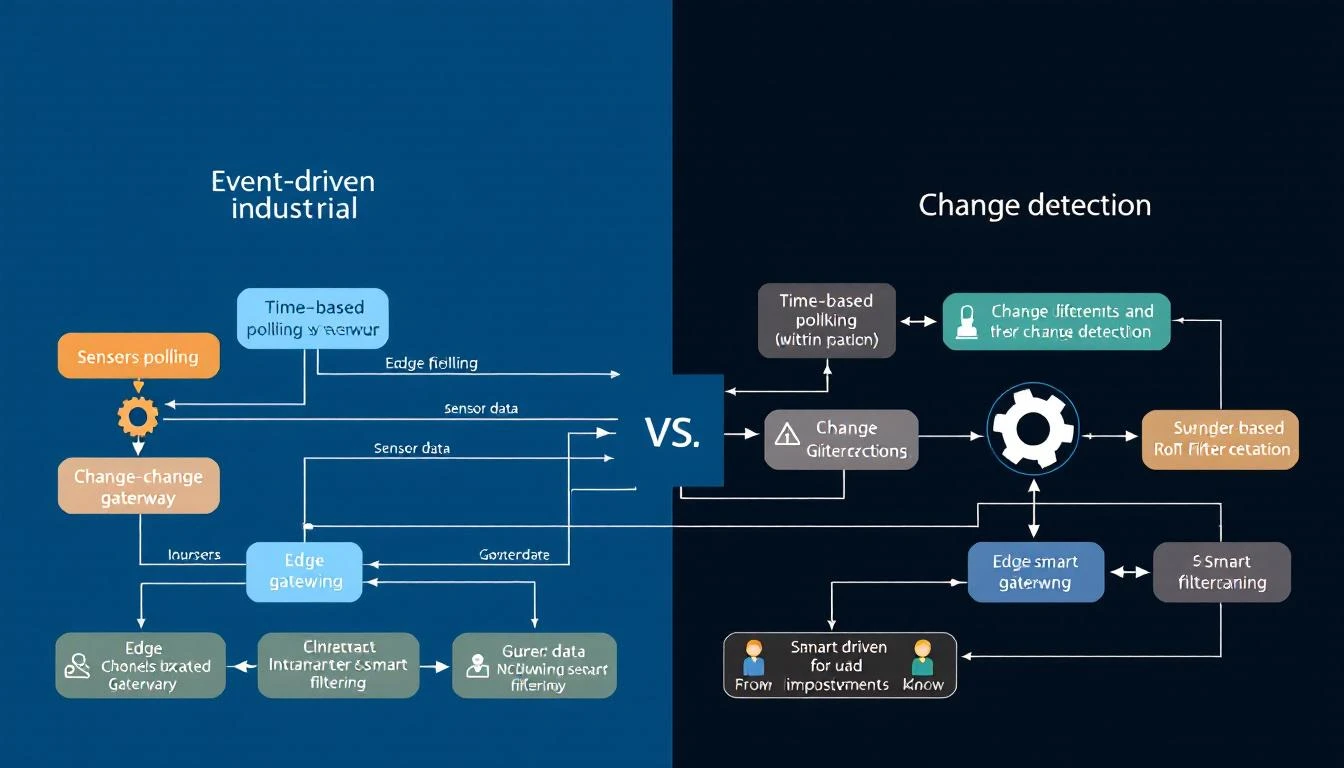
Most IIoT deployments start the same way: poll every PLC register every second, serialize all values to JSON, and push everything to the cloud over MQTT. It works — until your cellular data bill arrives, or your broker starts choking on 500,000 messages per day from a single gateway, or you realize that 95% of those messages contain values that haven't changed since the last read.
The reality of industrial data is that most values don't change most of the time. A chiller's tank temperature drifts by a fraction of a degree per minute. A blender's motor state is "running" for 8 hours straight. A conveyor's alarm register reads zero all day — until the instant it doesn't, and that instant matters more than the previous 86,400 identical readings.
This guide covers a smarter approach: event-driven tag delivery, where the edge gateway reads at regular intervals but only transmits when something actually changes — and when something does change, it can trigger reads of related tags for complete context.
The Problem with Fixed-Interval Everything
Let's quantify the waste. Consider a typical industrial chiller with 10 compressor circuits, each exposing 16 process tags (temperatures, pressures, flow rates) and 3 alarm registers:
Tags per circuit:  16 process + 3 alarm = 19 tags
Total tags:        10 circuits × 19 = 190 tags
Poll interval:     All at 1 second
At JSON format with timestamp, tag ID, and value, each data point is roughly 50 bytes. Per second, that's:
190 tags × 50 bytes = 9,500 bytes/second
= 570 KB/minute
= 34.2 MB/hour
= 821 MB/day
Over a cellular connection at $5/GB, that's $4.10/day per chiller — just for data that's overwhelmingly identical to what was sent one second ago.
Now let's separate the tags by their actual change frequency:
| Tag Type | Count | Actual Change Frequency | % of Total Data |
|---|---|---|---|
| Process temperatures | 100 | Every 30-60 seconds | 52.6% |
| Process pressures | 50 | Every 10-30 seconds | 26.3% |
| Flow rates | 10 | Every 5-15 seconds | 5.3% |
| Alarm bits | 30 | ~1-5 times per day | 15.8% |
Those 30 alarm registers — 15.8% of your data volume — change roughly 5 times per day. You're transmitting them 86,400 times. That's a 17,280x overhead on alarm data.
The Three Pillars of Event-Driven Delivery
A well-designed edge gateway implements three complementary strategies:
1. Compare-on-Read (Change Detection)
The simplest optimization: after reading a tag value from the PLC, compare it against the last transmitted value. If it hasn't changed, don't send it.
The implementation is straightforward:
# Pseudocode — NOT from any specific codebase
def should_deliver(tag, new_value, new_status):
    # Always deliver the first reading
    if not tag.has_been_read:
        return True

    # Always deliver on status change (device went offline/online)
    if tag.last_status != new_status:
        return True

    # Compare values if compare flag is enabled
    if tag.compare_enabled:
        if tag.last_value != new_value:
            return True
        return False  # Value unchanged, skip

    # If compare disabled, always deliver
    return True
Which tags should use change detection?
- Alarm/status registers: Always. These are event-driven by nature — you need the transitions, not the steady state.
- Digital I/O: Always. Binary values either changed or they didn't.
- Configuration registers: Always. Software version numbers, setpoints, and device parameters change rarely.
- Temperatures and pressures: Situational. If the process is stable, most readings are identical. But if you need trending data for analytics, you may want periodic delivery regardless.
- Counter registers: Never. Counters increment continuously — every reading is "different" — and you need the raw values for accurate rate calculations.
The gotcha with floating-point comparison: Comparing IEEE 754 floats for exact equality is unreliable due to rounding. For float-typed tags, use a deadband:
# Apply deadband for float comparison
def float_changed(old_val, new_val, deadband=0.1):
    return abs(new_val - old_val) > deadband
A temperature deadband of 0.1°F means you'll transmit when the temperature moves meaningfully, but ignore sensor noise.
2. Dependent Tags (Contextual Reads)
Here's where event-driven delivery gets powerful. Consider this scenario:
A chiller's compressor status word is a 16-bit register where each bit represents a different state: running, loaded, alarm, lockout, etc. You poll this register every second with change detection enabled. When bit 7 flips from 0 to 1 (alarm condition), you need more than just the status word — you need the discharge pressure, suction temperature, refrigerant level, and superheat at that exact moment to diagnose the alarm.
The solution: dependent tag chains. When a parent tag's value changes, the gateway immediately triggers a forced read of all dependent tags, delivering the complete snapshot:
Parent Tag:    Compressor Status Word (polled every 1s, compare=true)
Dependent Tags:
  ├── Discharge Pressure (read only when status changes)
  ├── Suction Temperature (read only when status changes)
  ├── Refrigerant Liquid Temp (read only when status changes)
  ├── Superheat (read only when status changes)
  └── Subcool (read only when status changes)
In normal operation, the gateway reads only the status word — one register per second per compressor. When the status word changes, it reads 6 registers total and delivers them as a single timestamped group. The result:
- Steady state: 1 register/second → 50 bytes/second
- Event triggered: 6 registers at once → 300 bytes (once, at the moment of change)
- vs. polling everything: 6 registers/second → 300 bytes/second (continuously)
Bandwidth savings: 99.8% during steady state, with zero data loss at the moment that matters.
3. Calculated Tags (Bit-Level Decomposition)
Industrial PLCs often pack multiple boolean signals into a single 16-bit or 32-bit "status word" or "alarm word." Each bit has a specific meaning defined in the PLC program documentation:
Alarm Word (uint16):
  Bit 0:  High Temperature Alarm
  Bit 1:  Low Pressure Alarm
  Bit 2:  Flow Switch Fault
  Bit 3:  Motor Overload
  Bit 4:  Sensor Open Circuit
  Bit 5:  Communication Fault
  Bits 6-15: Reserved
A naive approach reads the entire word and sends it to the cloud, leaving the bit-level parsing to the backend. A better approach: the edge gateway decomposes the word into individual boolean tags at read time.
The gateway reads the parent tag (the alarm word), and for each calculated tag, it applies a shift and mask operation to extract the individual bit:
Individual Alarm = (alarm_word >> bit_position) & mask
Each calculated tag gets its own change detection. So when Bit 2 (Flow Switch Fault) transitions from 0 to 1, the gateway transmits only that specific alarm — not the entire word, and not any unchanged bits.
Why this matters at scale: A 10-circuit chiller has 30 alarm registers (3 per circuit), each 16 bits wide. That's 480 individual alarm conditions. Without bit decomposition, a single bit flip in one register transmits all 30 registers (because the polling cycle doesn't know which register changed). With calculated tags, only the one changed boolean is transmitted.
Batching: Grouping Efficiency
Even with change detection, transmitting each changed tag as an individual MQTT message creates excessive overhead. MQTT headers, TLS framing, and TCP acknowledgments add 80-100 bytes of overhead per message. A 50-byte tag value in a 130-byte envelope is 62% overhead.
The solution: time-bounded batching. The gateway accumulates changed tag values into a batch, then transmits the batch when either:
- The batch reaches a size threshold (e.g., 4KB of accumulated data)
- A time limit expires (e.g., 10-30 seconds since the batch started collecting)
The batch structure groups values by timestamp:
{
  "groups": [
    {
      "ts": 1709335200,
      "device_type": 1018,
      "serial_number": 2411001,
      "values": [
        {"id": 1, "values": [245]},
        {"id": 6, "values": [187]},
        {"id": 7, "values": [42]}
      ]
    }
  ]
}
Critical exception: alarm tags bypass batching. When a status register changes, you don't want the alarm notification sitting in a batch buffer for 30 seconds. Alarm tags should be marked as do_not_batch — they're serialized and transmitted immediately as individual messages with QoS 1 delivery confirmation.
This creates a two-tier delivery system:
| Data Type | Delivery | Latency | Batching |
|---|---|---|---|
| Process values | Change-detected, batched | 10-30 seconds | Yes |
| Alarm/status bits | Change-detected, immediate | <1 second | No |
| Periodic values | Time-based, batched | 10-60 seconds | Yes |
Binary vs. JSON: The Encoding Decision
The batch payload format has a surprisingly large impact on bandwidth. Consider a batch with 50 tag values:
JSON format:
{"groups":[{"ts":1709335200,"device_type":1018,"serial_number":2411001,"values":[{"id":1,"values":[245]},{"id":2,"values":[187]},...]}]}
Typical size: 2,500-3,000 bytes for 50 values
Binary format:
Header:     1 byte  (magic byte 0xF7)
Group count: 4 bytes
Per group:
  Timestamp:      4 bytes
  Device type:    2 bytes
  Serial number:  4 bytes
  Value count:    4 bytes
  Per value:
    Tag ID:       2 bytes
    Status:       1 byte
    Value count:  1 byte
    Value size:   1 byte (1=bool/int8, 2=int16, 4=int32/float)
    Values:       1-4 bytes each
Typical size: 400-600 bytes for 50 values
That's a 5-7x reduction — from 3KB to ~500 bytes per batch. Over cellular, this is transformative. A device that transmits 34 MB/day in JSON drops to 5-7 MB/day in binary, before even accounting for change detection.
The trade-off: binary payloads require a schema-aware decoder on the cloud side. Both the gateway and the backend must agree on the encoding format. In practice, most production IIoT platforms use binary encoding for device-to-cloud telemetry and JSON for cloud-to-device commands (where human readability matters and message volume is low).
The Hourly Reset: Catching Drift
One subtle problem with pure change detection: if a value drifts by tiny increments — each below the comparison threshold — the cloud's cached value can slowly diverge from reality. After hours of accumulated micro-drift, the dashboard shows 72.3°F while the actual temperature is 74.1°F.
The solution: periodic forced reads. Every hour (or at another configurable interval), the gateway resets all "read once" flags and forces a complete read of every tag, delivering all current values regardless of change. This acts as a synchronization pulse that corrects any accumulated drift and confirms that all devices are still online.
The hourly reset typically generates one large batch — a snapshot of all 190 tags — adding roughly 10-15KB once per hour. That's negligible compared to the savings from change detection during the other 3,599 seconds.
Quantifying the Savings
Let's revisit our 10-circuit chiller example with event-driven delivery:
Before (fixed interval, everything at 1s):
190 tags × 86,400 seconds × 50 bytes = 821 MB/day
After (event-driven with change detection):
Process values: 160 tags × avg 2 changes/min × 1440 min × 50 bytes = 23 MB/day
Alarm bits:     30 tags × avg 5 changes/day × 50 bytes            = 7.5 KB/day
Hourly resets:  190 tags × 24 resets × 50 bytes                   = 228 KB/day
Overhead (headers, keepalives):                                   ≈ 2 MB/day
──────────────────────────────────────────────────────
Total:                                                            ≈ 25.2 MB/day
With binary encoding instead of JSON:
≈ 25.2 MB/day ÷ 5.5 (binary compression) ≈ 4.6 MB/day
Net reduction: 821 MB → 4.6 MB = 99.4% bandwidth savings.
On a $5/GB cellular plan, that's $4.10/day → $0.02/day per chiller.
Implementation Checklist
If you're building or evaluating an edge gateway for event-driven tag delivery, here's what to look for:
- Per-tag compare flag — Can you enable/disable change detection per tag?
- Per-tag polling interval — Can fast-changing and slow-changing tags have different read rates?
- Dependent tag chains — Can a parent tag's change trigger reads of related tags?
- Bit-level calculated tags — Can alarm words be decomposed into individual booleans?
- Bypass batching for alarms — Are alarm tags delivered immediately, bypassing the batch buffer?
- Binary encoding option — Can the gateway serialize in binary instead of JSON?
- Periodic forced sync — Does the gateway do hourly (or configurable) full reads?
- Link state tracking — Is device online/offline status treated as a first-class event?
How machineCDN Handles Event-Driven Delivery
machineCDN's edge gateway implements all of these strategies natively. Every tag in the device configuration carries its own polling interval, change detection flag, and batch/immediate delivery preference. Alarm registers are automatically configured for 1-second polling with change detection and immediate delivery. Process values use configurable intervals with batched transmission. The gateway supports both JSON and compact binary encoding, with automatic store-and-forward buffering that retains data through connectivity outages.
The result: plants running machineCDN gateways over cellular connections typically see 95-99% lower data volumes compared to naive fixed-interval polling — without losing a single alarm event or meaningful process change.
Tired of paying for the same unchanged data point 86,400 times a day? machineCDN delivers only the data that matters — alarms instantly, process values on change, with full periodic sync. See how much bandwidth you can save.
