Best Smart Factory Software 2026: Platforms That Actually Deliver Industry 4.0

"Smart factory" has become one of the most overused terms in manufacturing technology. Every software vendor claims to deliver Industry 4.0 capabilities, but most manufacturers who've attempted digital transformation know the painful truth: the gap between the conference keynote and the factory floor is measured in millions of dollars and years of failed implementations.
According to a 2025 Deloitte study, only 26% of smart factory initiatives achieve their projected ROI within the expected timeframe. The remaining 74% either take significantly longer, deliver reduced benefits, or stall entirely. The problem isn't the vision — it's the execution.
This guide cuts through the marketing to evaluate smart factory software platforms that actually deliver measurable results for manufacturing operations in 2026.
What Actually Makes a Factory "Smart"?
Before evaluating software, let's define what a smart factory actually looks like in practice — not in a Gartner Magic Quadrant, but on a factory floor that's running three shifts.
Level 1: Visibility
You can see what's happening across your machines in real time. Machine status, utilization rates, and basic alerts are available on dashboards without walking the floor.
Level 2: Analysis
You understand why things happen. OEE breakdowns show whether availability, performance, or quality is your bottleneck. Downtime analysis categorizes root causes. Trend data reveals patterns.
Level 3: Prediction
You know what will happen before it does. Predictive maintenance identifies failing components before they cause unplanned downtime. Anomaly detection catches deviations from normal operating parameters.
Level 4: Optimization
The system recommends (or autonomously implements) improvements. AI-driven scheduling, automated changeover optimization, and energy management operate with minimal human intervention.
Most manufacturers talking about "smart factory" are realistically at Level 0 (manual data collection) or Level 1 (basic monitoring). The software you choose determines how quickly you can progress through these levels — and critically, whether you can start generating value at Level 1 while building toward Level 3 and 4.
Top Smart Factory Software Platforms
1. MachineCDN — Best for Progressive Smart Factory Adoption
MachineCDN's approach to smart factory implementation is pragmatic: start monitoring today, add predictive intelligence as data accumulates, and scale across your entire operation without rearchitecting.
Why it leads for smart factory implementation:
Most smart factory platforms require you to design the entire architecture upfront — data models, integration flows, analytics pipelines, dashboard hierarchies. MachineCDN inverts this: plug in a device, get monitoring. As data accumulates, predictive models activate automatically. No separate project phases, no additional software, no data science engagement.
Smart factory capabilities:
- Real-time machine monitoring across all locations and zones
- AI-powered predictive maintenance — learns equipment patterns over time
- Automated OEE tracking — no manual data entry or operator burden
- Threshold-based intelligent alerting with approaching-alarm warnings
- Downtime root cause analysis — categorize and trend downtime reasons
- Energy consumption monitoring — visibility into per-machine energy use
- Fleet management — centralized view of multi-site operations
- Materials and inventory management — connected to machine operations
- Spare parts tracking — tie parts availability to maintenance schedules
What makes it different: Cellular connectivity means you can add machines to your smart factory initiative without any IT infrastructure changes. This is why MachineCDN deployments go from zero to live monitoring in days while competitors take months. Every week you spend deploying is a week of downtime you didn't prevent.
2. Siemens Xcelerator — Best for Siemens-Integrated Shops
Siemens' Xcelerator portfolio is the most comprehensive smart factory ecosystem from a single vendor — spanning PLCs, drives, SCADA, MES, PLM, and cloud analytics.
Key components:
- Insights Hub (MindSphere) — cloud IoT analytics
- SIMATIC IT — MES for production execution
- Teamcenter — product lifecycle management
- Industrial Edge — edge computing platform
- Opcenter — manufacturing operations management
Best for: Factories with 80%+ Siemens automation. The deeper your Siemens install base, the more value Xcelerator delivers through native integration.
Limitations: Expensive, complex, and heavily Siemens-centric. Multi-vendor environments require significant integration effort.
3. PTC — Best for AR-Enhanced Operations
PTC combines IoT (ThingWorx), CAD (Creo), PLM (Windchill), and augmented reality (Vuforia) into a smart factory platform that connects digital design to physical operations.
Key strengths:
- Digital twin creation from CAD models
- AR-guided work instructions and remote assistance
- Strong IoT data collection via Kepware
- ServiceMax integration for field service
Best for: Manufacturers where AR work instructions, digital twins, and the design-to-operations connection create measurable value — typically complex assembly operations.
Limitations: Significant implementation investment. Best value when you use multiple PTC products. ThingWorx alone is expensive relative to purpose-built monitoring tools.
4. Rockwell Automation FactoryTalk — Best for Allen-Bradley Shops
FactoryTalk is Rockwell's software portfolio for manufacturing operations, spanning HMI/SCADA, MES, analytics, and industrial IoT.
Key components:
- FactoryTalk Optix — modern HMI/visualization
- FactoryTalk InnovationSuite (with PTC) — IoT and analytics
- Plex MES — cloud-native manufacturing execution
- Fiix — AI-powered CMMS
- FactoryTalk Analytics — edge and cloud analytics
Best for: Plants with significant Rockwell/Allen-Bradley PLC install bases. The joint PTC partnership brings ThingWorx capabilities into the Rockwell ecosystem.
Limitations: Fragmented portfolio (multiple acquisitions) that doesn't always integrate seamlessly. Enterprise pricing and complexity.
5. AWS IoT for Manufacturing — Best for AWS Ecosystem
Amazon's manufacturing IoT solution combines IoT SiteWise, IoT Greengrass, Lookout for Equipment, and Monitron into a modular smart factory toolkit.
Key strengths:
- Virtually unlimited scalability
- Integration with the full AWS ecosystem (SageMaker, Redshift, QuickSight)
- AWS Monitron for vibration monitoring (hardware + software)
- Pay-as-you-go pricing model
Best for: Organizations with strong AWS competency and development teams who want to build custom solutions on cloud infrastructure.
Limitations: You're assembling components, not deploying a solution. Requires significant development effort and ongoing engineering resources.
6. Tulip — Best for Citizen Development
Tulip's no-code manufacturing app platform enables frontline engineers to build their own smart factory applications — from quality inspection to machine monitoring to digital work instructions.
Key strengths:
- No-code app builder designed for manufacturing
- Edge IO device for machine connectivity
- Machine vision and barcode scanning
- Rapid iteration on manufacturing apps
Best for: Organizations with tech-savvy manufacturing engineers who want to build custom solutions without waiting for IT. Particularly strong for quality management and assembly operations.
7. Sight Machine — Best for Enterprise Analytics
Sight Machine focuses on manufacturing data analytics at scale, using AI to analyze production data and identify optimization opportunities across entire manufacturing networks.
Key strengths:
- AI-powered root cause analysis
- Cross-plant performance benchmarking
- Strong automotive and CPG industry models
- Executive-level reporting and insights
Best for: Large manufacturers with 10+ plants who need enterprise analytics and benchmarking. Requires existing data infrastructure.
8. AVEVA (Schneider Electric) — Best for Process Manufacturing
AVEVA's portfolio covers process manufacturing end-to-end: from design (E3D) through operations (System Platform) to performance management.
Best for: Process industries (chemicals, oil & gas, pharma, food & beverage) where batch management, recipe control, and regulatory compliance are primary requirements.
What Most Smart Factory Implementations Get Wrong
After reviewing hundreds of smart factory initiatives, the failure patterns are remarkably consistent:
1. Over-Architecting the Solution
The most common failure is spending 12-18 months designing the perfect smart factory architecture before connecting a single machine. By the time the pilot launches, executive sponsorship has wavered, budgets have been reallocated, and the team that championed the initiative has moved on.
The fix: Start with monitoring. Connect 10 machines. Show live data to operations leadership. Demonstrate a prevented downtime event. Then expand. The platform that enables this rapid start wins — not the one with the most impressive architecture diagram.
2. Requiring IT Infrastructure Changes
Every smart factory project that requires plant network changes faces the same gauntlet: cybersecurity review, network segmentation design, firewall rule configuration, penetration testing, and compliance documentation. In heavily regulated industries, this process alone can take 6-12 months.
The fix: Use network-independent connectivity. Cellular solutions bypass the entire IT infrastructure conversation. Your first 10 machines can be monitored while the IT team evaluates network options for eventual integration.
3. Buying Technology Before Defining Problems
Manufacturers purchase MES, SCADA, IoT platforms, and AI analytics — then try to figure out what problem to solve with them. The technology becomes a solution looking for a problem.
The fix: Start with your most painful operational problem. Is it unplanned downtime? Low OEE? Energy costs? Quality rejects? Choose the software that solves that specific problem fastest, then expand.
4. Ignoring Operator Adoption
A smart factory dashboard that nobody looks at is expensive wallpaper. If operators and engineers aren't using the system daily, no amount of AI and analytics will generate value.
The fix: Choose software with intuitive interfaces designed for manufacturing users — not data scientists. Alerting systems that push information to the right person at the right time beat dashboards that require login and navigation.
Building a Smart Factory Roadmap That Works
Based on successful implementations, here's a pragmatic roadmap:
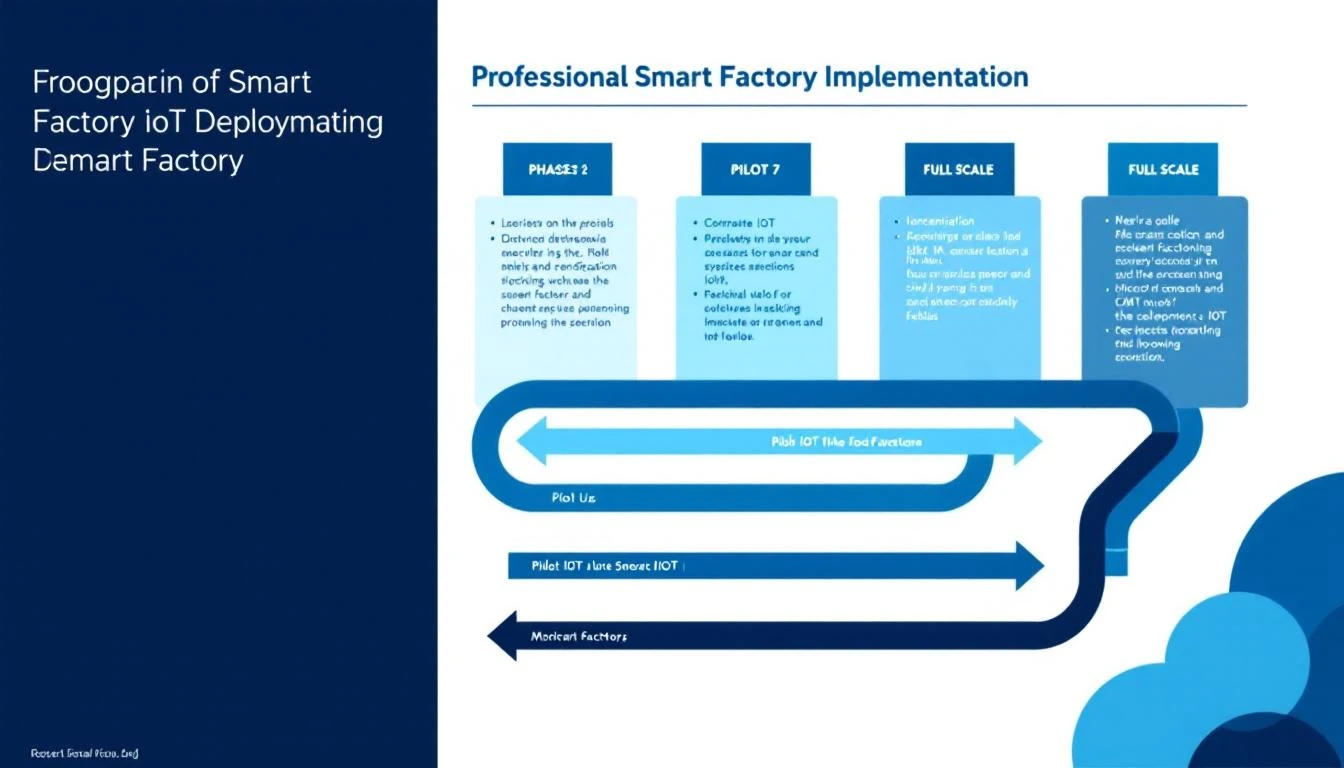
Phase 1: Foundation (Weeks 1-4)
- Connect 5-10 machines on your most critical production line
- Deploy real-time monitoring with status dashboards
- Set up basic alerting (downtime, alarms)
- Goal: Visibility into actual equipment behavior
Phase 2: Analysis (Weeks 4-12)
- Add OEE tracking and downtime categorization
- Establish baseline metrics (availability, performance, quality)
- Identify top 5 downtime causes from data
- Goal: Data-driven understanding of losses
Phase 3: Prediction (Months 3-6)
- Enable predictive maintenance models as data matures
- Set up threshold alerts for approaching-failure conditions
- Begin preventive maintenance optimization
- Goal: Prevent failures before they occur
Phase 4: Scale (Months 6-12)
- Expand to all production equipment
- Add materials tracking and energy monitoring
- Deploy fleet management for multi-site visibility
- Goal: Facility-wide operational intelligence
Phase 5: Optimization (Month 12+)
- AI-driven scheduling and resource optimization
- Cross-site benchmarking and best practice identification
- Autonomous alerting and recommendation systems
- Goal: Continuous, data-driven improvement
The Bottom Line
The smart factory isn't a destination — it's a progression. And the biggest risk isn't choosing the wrong technology; it's choosing technology that takes so long to deploy that you never reach the starting line.
The platforms that succeed in real manufacturing environments share common traits: they connect quickly, they deliver value immediately, and they scale without requiring architectural redesigns. The ones that fail demand perfection before they deliver anything.
MachineCDN was designed around this reality. Plug in a device, see your machines, start improving. Smart doesn't mean complicated — it means informed.
Related Reading:
- Industry 4.0 Implementation Guide
- Edge Computing in Manufacturing
- AI in Manufacturing: What's Real vs. What's Hype
- Getting Started with IIoT
- Best IIoT Platform 2026
Start your smart factory with the machine you're most worried about. Book a demo with MachineCDN and see live data in minutes.