IIoT for Automotive Manufacturing: A Practical Guide to Connecting Your Stamping, Welding, and Assembly Lines

Automotive manufacturing is one of the most demanding environments for Industrial IoT. The combination of high-speed production, tight quality tolerances, multi-process workflows, and enormous downtime costs creates both the strongest need and the highest bar for IIoT platforms.
If you're running stamping presses, robotic welding cells, paint systems, or final assembly lines, here's what IIoT actually looks like in automotive — beyond the vendor brochures.

Why Automotive Is Different from General Manufacturing
Automotive manufacturing has characteristics that make IIoT both more valuable and more demanding than in most industries:
Production Volume Magnifies Everything
A stamping press running at 15 strokes per minute produces 900 parts per hour. At $50 per part in downstream value, every hour of downtime costs $45,000 — and that's before you account for downstream line stoppages. According to IndustryWeek, automotive OEMs lose an average of $22,000 per minute of unplanned downtime.
Quality Is Non-Negotiable
A bearing that's slightly out of spec in consumer goods means a return. In automotive, it means a recall affecting millions of vehicles, regulatory scrutiny, and brand damage measured in billions. OEE quality tracking in automotive must be precise, traceable, and connected to specific process parameters.
Multi-Process Dependencies
Automotive production is sequential: stamping → welding → paint → assembly → test. A problem in stamping cascades through every downstream process. IIoT must provide visibility across the entire value chain, not just individual machines.
Tier 1 Supplier Pressure
OEMs increasingly require suppliers to demonstrate process monitoring capabilities. Tier 1 and Tier 2 suppliers face customer mandates for real-time quality data, SPC (statistical process control), and traceability — making IIoT a customer requirement, not just an internal efficiency tool.
IIoT Applications by Automotive Process
Stamping Operations
Stamping presses are among the most critical and expensive assets in automotive manufacturing. They operate at high speeds, high forces, and tight tolerances — any deviation in die condition, material properties, or press alignment shows up immediately in part quality.
What IIoT monitors in stamping:
- Press tonnage per stroke — trending tonnage reveals die wear before it produces out-of-spec parts
- Stroke rate and cycle time — deviations from target cycle time indicate mechanical issues
- Die temperature — thermal expansion affects dimensional accuracy
- Cushion pressure — hydraulic cushion degradation causes draw defects
- Counterbalance pressure — imbalanced slide motion produces uneven draws
- Parts per shift/day — real-time production counting against schedule
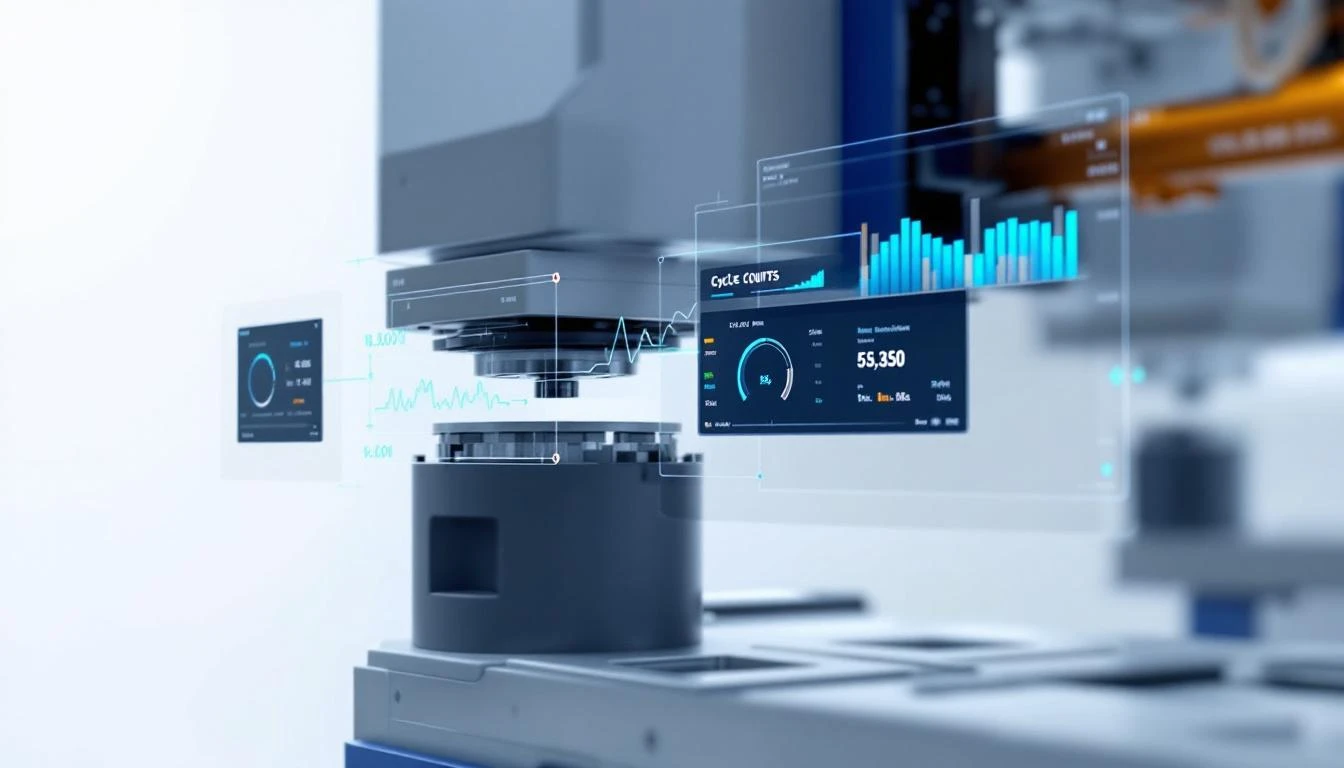
How MachineCDN helps: Direct PLC connectivity reads press controller data — tonnage, stroke count, temperatures, pressures — without additional sensors. The platform's threshold alerting can flag die wear trends (rising tonnage) before quality is affected. Three-minute setup per press means a stamping shop with 20 presses can be fully connected in a single shift.
Robotic Welding
Welding robots are the most automated segment of automotive production, but their monitoring is often surprisingly manual. Operators check weld quality through destructive testing on sample parts, catching systematic issues only after hundreds of parts have been welded.
What IIoT monitors in welding:
- Weld current and voltage — deviations indicate electrode wear, poor contact, or material variation
- Wire feed speed — MIG/MAG wire feed consistency affects weld quality
- Gas flow rate — shielding gas variations cause porosity
- Cycle time per station — identifies stations creating bottlenecks
- Robot fault codes — specific alarm codes from the robot controller identify maintenance needs
- Tip dressing frequency — spot weld tip condition directly affects weld strength
How MachineCDN helps: By reading data directly from welding robot controllers through industrial protocols, MachineCDN captures weld parameters at the controller level. The alarm management system tracks robot fault codes fleet-wide, identifying which fault types are most frequent and which cells need attention across an entire welding body shop.
Paint Systems
Paint operations are the most environmentally sensitive area of automotive manufacturing. Temperature, humidity, air flow, and contamination control directly affect paint quality — and paint rework is one of the most expensive quality failures in automotive.
What IIoT monitors in paint:
- Booth temperature and humidity — the primary drivers of paint adhesion and finish quality
- Air flow velocity and balance — contamination control depends on positive pressure and balanced flow
- Paint viscosity and pressure — material delivery consistency
- Oven temperature profiles — cure consistency across the conveyor
- Solvent concentration — environmental compliance and explosion prevention
- Energy consumption — paint operations consume 50-60% of a plant's total energy
How MachineCDN helps: Environmental parameter monitoring through PLC-connected HVAC controls, booth instrumentation, and oven controls. MachineCDN's energy monitoring capabilities are particularly relevant in paint — where energy costs can exceed $2M/year for a single paint shop.
Final Assembly
Assembly lines combine automated stations with manual operations. The IIoT challenge is providing visibility across both — tracking equipment uptime for automated torque tools, presses, and test stations while monitoring line pace and station cycle times.
What IIoT monitors in assembly:
- Torque tool values — critical fastener torque verification with SPC tracking
- Press force curves — bearing and bushing installation press quality
- Test station results — leak tests, electrical tests, functional tests
- Line speed and takt time — production pace against customer demand
- Station cycle times — identifying bottleneck stations
- Andon call frequency — quality issue patterns by station and shift
How MachineCDN helps: MachineCDN's multi-zone organization maps naturally to assembly line stations. Fleet management views show performance across multiple assembly lines or plants, with drill-down to individual station data.
Automotive-Specific IIoT Requirements
Beyond standard IIoT capabilities, automotive manufacturers need:
Traceability
Every part must be traceable to the specific machine, die, weld cell, and process parameters that produced it. IIoT platforms must link production data to serial numbers or batch codes for warranty and recall investigation.
SPC Integration
Statistical process control is mandatory in automotive — Cpk, Ppk, control charts, and capability studies drive quality management. IIoT data feeds SPC calculations, replacing manual measurement sampling with continuous process monitoring.
Customer Portal Access
OEMs often require Tier 1 suppliers to provide real-time or near-real-time production and quality dashboards. Multi-tenant IIoT platforms that support customer access without exposing internal data address this requirement directly. MachineCDN's multi-tenant architecture with company-level isolation and configurable user roles supports this OEM requirement.
IATF 16949 Compliance Support
Automotive quality management under IATF 16949 requires documented control plans, FMEA-linked monitoring, and evidence of continuous improvement. IIoT platforms that provide historical data, threshold alerting documentation, and custom reporting help demonstrate compliance during audits.
ROI Framework for Automotive IIoT
Downtime Reduction
At $22,000/minute, preventing even one major unplanned downtime event per month justifies most IIoT deployments. MachineCDN's threshold alerting and alarm management provide early warning that enables planned repairs during scheduled maintenance windows.
Conservative estimate: 1 prevented 4-hour event per quarter = $5.28M/year in avoided losses.
Quality Improvement
Connecting process parameters to quality outcomes enables statistical intervention before defect rates rise. Monitoring tonnage trends in stamping, weld parameters in body shop, and torque values in assembly catches drift before it produces scrap.
Conservative estimate: 0.5% reduction in scrap rate on $50M annual production = $250K/year.
Energy Optimization
Automotive plants consume 15-25 MW of electricity. Paint booths, HVAC, and curing ovens represent 60-70% of consumption. Monitoring energy per machine through IIoT identifies waste and supports ISO 50001 energy management compliance.
Conservative estimate: 5% energy reduction on $3M annual utility cost = $150K/year.
Maintenance Optimization
Shifting from time-based to condition-based maintenance reduces both maintenance costs and unplanned downtime. MachineCDN's PM scheduling tied to actual machine data replaces conservative calendar-based intervals with data-driven scheduling.
Conservative estimate: 20% reduction in $2M annual maintenance budget = $400K/year.
Implementation Roadmap for Automotive Plants
Phase 1: Critical Press Monitoring (Week 1-2)
Start with your highest-value stamping presses. Connect to PLC data, configure threshold alerts for tonnage, temperature, and cycle time. With MachineCDN's 3-minute setup, a 10-press line can be monitored within a single shift.
Phase 2: Welding and Paint (Week 3-6)
Expand to welding cell controllers and paint booth instrumentation. Establish cross-process visibility linking stamping output to welding input quality.
Phase 3: Assembly and Test (Week 7-10)
Connect assembly station equipment — torque tools, press stations, test equipment. Map the complete value chain from stamping through final test.
Phase 4: Fleet Management and Optimization (Ongoing)
Use fleet management views to compare performance across lines, shifts, and plants. Establish cross-site benchmarks and drive continuous improvement through data-driven best practice transfer.
Getting Started
Automotive manufacturing's combination of high production volumes, tight quality requirements, and enormous downtime costs makes IIoT deployment not a question of "if" but "when and how." The platforms that win in automotive are those that connect directly to the controllers running your equipment, deploy in minutes rather than months, and provide both the real-time visibility and the historical data your quality system demands.
See how your stamping presses, welding cells, and assembly lines look on one dashboard. Book a MachineCDN demo and connect your first machine in under 5 minutes.