Manufacturing Data Analytics: How to Turn Machine Data Into Decisions That Actually Improve Operations

Manufacturing generates more data per day than most industries generate in a month. A single CNC machine produces 2,000-5,000 data points per second. A factory floor with 50 machines generates hundreds of millions of readings daily. Yet most manufacturers use less than 5% of this data for decision-making. The rest evaporates — never captured, never analyzed, never turned into the insights that separate world-class operations from average ones. This guide is about closing that gap: not with a theoretical framework, but with a practical playbook for capturing, analyzing, and acting on manufacturing data.
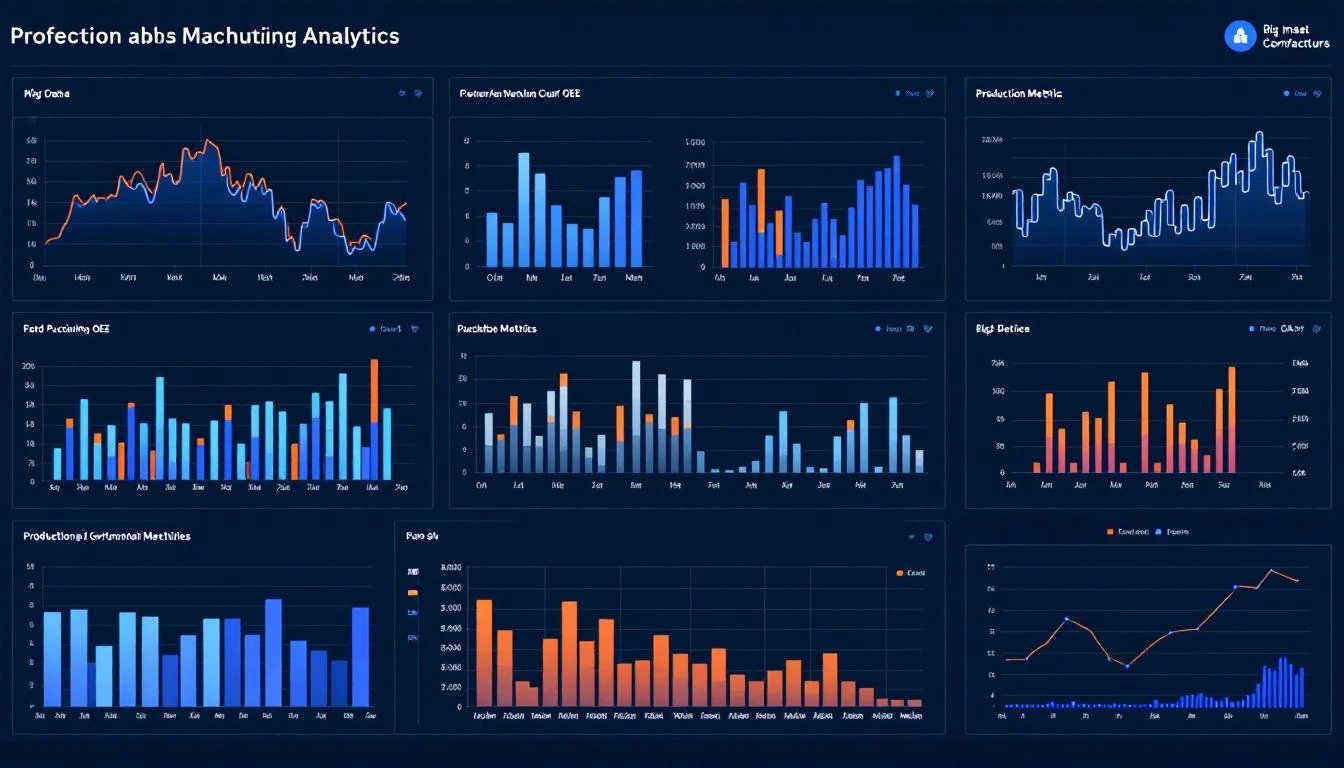
Why Most Manufacturing Analytics Projects Fail
Before diving into how to do analytics right, let's understand why most projects don't deliver value. A McKinsey study found that only 20-30% of manufacturing analytics initiatives achieve their intended impact. The failures typically share common patterns:
Problem 1: Starting with the technology, not the question. Teams buy a data platform, connect everything, and then ask "what should we look at?" Analytics projects that start without a specific business question generate dashboards nobody uses.
Problem 2: Collecting data without context. Raw sensor data without operational context is noise. A temperature reading of 185°F means nothing until you know which machine, which process, which product was running, and whether the machine was in normal operation, startup, or changeover.
Problem 3: Building dashboards instead of decision systems. A dashboard that shows OEE is informational. A system that tells the shift supervisor "Line 3 OEE dropped 8% in the last hour because changeover time increased by 12 minutes — here are the three most likely causes" is actionable.
Problem 4: Ignoring the people. The best analytics platform in the world delivers zero value if operators and supervisors don't trust it, understand it, or have time to look at it. The human interface is as important as the data pipeline.
The Four Levels of Manufacturing Analytics
Manufacturing analytics follows a maturity curve. Each level builds on the previous one:
Level 1: Descriptive — What Happened?
This is where most manufacturers start. Descriptive analytics answers:
- How many parts did we produce yesterday?
- What was our OEE last week?
- How many hours of downtime did we have?
- What was our scrap rate by shift?
Data requirements: Production counts, downtime logs, quality records. Most of this exists in your CMMS, MES, or even spreadsheets.
Value: Baseline visibility. You can't improve what you don't measure. But descriptive analytics alone only tells you about the past — it doesn't explain why things happened or what to do about it.
Level 2: Diagnostic — Why Did It Happen?
Diagnostic analytics digs into root causes:
- Why did Line 2's OEE drop last Tuesday?
- What caused the spike in scrap during the night shift?
- Why does Machine 7 have 40% more downtime than Machine 8 (same model, same age)?
Data requirements: Descriptive data plus machine-level operational data (temperatures, pressures, speeds, currents, vibration). This is where IIoT becomes essential — you need continuous machine data correlated with production outcomes.
Value: Understanding causation lets you prevent recurrence. When you know that Line 2's OEE dropped because a servo motor was overheating due to a clogged cooling filter, you can add filter condition monitoring to prevent it from happening again.
Level 3: Predictive — What Will Happen?
Predictive analytics uses historical patterns to forecast future events:
- This motor's vibration pattern matches the pattern that preceded the last three failures — predict failure in 2-4 weeks
- Based on current wear rates, this cutting tool will exceed tolerance limits in approximately 450 more cycles
- If ambient temperature exceeds 95°F tomorrow, this heat exchanger will approach its capacity limit by 2 PM
Data requirements: Months of continuous machine data, failure records, process parameters. AI and machine learning models trained on your specific equipment and operating conditions.
Value: Predictive analytics is the foundation of predictive maintenance, predictive quality, and production planning optimization. It shifts maintenance from reactive to proactive and quality from inspection to prevention.
Level 4: Prescriptive — What Should We Do?
Prescriptive analytics recommends specific actions:
- "Bearing 3A on Pump 7 shows early-stage outer race degradation. Schedule replacement during the planned shutdown on March 15. Estimated remaining life: 3-5 weeks. Parts needed: SKF 6312-2RS1."
- "OEE will improve 4.2% if you move the Tuesday PM task on Line 3 to Wednesday, avoiding the overlap with the shift change."
- "Tool life on Operation 30 can be extended 15% by reducing feed rate from 0.008 to 0.007 ipr during the final pass."
Data requirements: Everything from Levels 1-3, plus maintenance history, parts inventory, production schedules, and cost data. AI models that understand not just what's happening, but what the optimal response is.
Value: Prescriptive analytics closes the loop from insight to action. It doesn't just tell you a problem exists — it tells you exactly what to do about it, when to do it, and what the impact will be.

Building Your Data Foundation
Step 1: Identify Your Decision Points
Before connecting anything, list the top 10 decisions your plant makes daily that could benefit from better data:
- Which machines need attention today?
- Are we on track for the daily production target?
- Is product quality trending in the right direction?
- Are we consuming energy efficiently?
- Do we need to adjust any process parameters?
- Is the next shift set up for success?
- Which maintenance work orders should we prioritize?
- Are any machines showing signs of degradation?
- Are changeover times within standards?
- Should we adjust the production schedule?
Each decision point defines what data you need and how it needs to be presented.
Step 2: Map Your Data Sources
Manufacturing data lives in many places:
| Data Source | Data Types | Collection Method |
|---|---|---|
| PLCs | Machine states, temperatures, pressures, speeds, counts | Direct (Ethernet/IP, Modbus, OPC UA) |
| CNC controllers | Spindle loads, feed rates, tool life, alarms | Direct or MTConnect |
| Sensors (standalone) | Vibration, temperature, humidity, flow | Wireless or wired to edge device |
| CMMS | Work orders, maintenance history, parts usage | API integration |
| MES | Production schedules, batch records, quality data | API integration |
| ERP | Materials, costs, labor, orders | API integration |
| Quality systems | Inspection results, SPC data, non-conformances | API or manual import |
| Energy meters | Power consumption per machine or circuit | Direct or utility feed |
The most critical data source is the PLC. This is where real-time machine state lives, and it's typically the hardest to access — not because the technology is difficult, but because IT and OT teams need to agree on access methods.
Step 3: Deploy Edge-Based Data Collection
The fastest path from "we should monitor our machines" to "we're monitoring our machines" is edge-based data collection. Platforms like MachineCDN deploy industrial edge devices that:
- Connect directly to PLCs via standard protocols (Ethernet/IP, Modbus TCP/RTU)
- Use cellular connectivity — no plant network modifications required
- Process data locally for time-sensitive alerts
- Stream data to the cloud for historical analysis and AI
The critical advantage of edge-based collection: deployment happens in minutes, not months. No IT infrastructure projects. No network architecture debates. No 6-month implementation timelines.
Step 4: Contextualize Your Data
Raw machine data needs context to become useful. Essential context includes:
Production context: What product was running? Which work order? What shift? Which operator? Without this, a temperature spike is just a data point. With this, it's "the temperature spike on Machine 5 during Product X on Second Shift — which is the third time this has happened with this product recipe."
Maintenance context: Was the machine just serviced? When was the last PM? Are there known issues? Correlating machine data with maintenance history reveals patterns invisible to either dataset alone.
Environmental context: Ambient temperature, humidity, seasonal variations. Many process deviations correlate with environmental conditions that vary throughout the day and across seasons.
Practical Analytics Use Cases That Deliver ROI
Use Case 1: Real-Time OEE with Root Cause
Traditional OEE is calculated after the fact — typically the next day or week. Real-time OEE provides second-by-second visibility into:
- Availability: Is the machine running? If not, why not? (Categorized downtime reasons)
- Performance: Is it running at target speed? If not, how much slower and since when?
- Quality: Are we producing good parts? What's the current reject rate?
The insight: When OEE drops, the system immediately identifies which component (availability, performance, or quality) drove the drop and surfaces the most likely root cause from historical patterns. Learn more about how to calculate and improve OEE.
Use Case 2: Energy Per Unit Produced
Manufacturing energy costs are typically allocated by area or building, not by product or machine. When you connect machine-level energy monitoring with production data, you can calculate:
- Energy cost per unit produced (by product, machine, and shift)
- Energy waste during non-productive time (idle machines, weekend standby)
- Correlation between energy consumption and product quality
- Optimal operating parameters for energy efficiency
Typical finding: 15-30% of factory energy consumption occurs during non-productive time. Simply shutting down or reducing idle machines during planned breaks can save 5-10% of the total energy bill.
Use Case 3: Cross-Machine Failure Pattern Detection
Individual machine monitoring catches single-machine issues. Cross-fleet analytics catches systemic issues:
- All Machine Type X units show increased vibration after a specific maintenance procedure — the procedure is introducing misalignment
- Failure rates correlate with a specific raw material lot — material quality issue
- Machines in Zone B fail more often than identical machines in Zone A — environmental factor (temperature, humidity, vibration from adjacent equipment)
These patterns are invisible without centralized analytics across your entire machine fleet.
Use Case 4: Changeover Time Optimization
Changeover (setup time between production runs) is often the biggest OEE availability loss. Analytics helps by:
- Measuring actual changeover time versus standard (automatically, from machine data)
- Identifying which changeovers take longest and why
- Detecting best practices from operators who consistently achieve faster changeovers
- Tracking improvement over time as SMED (Single-Minute Exchange of Die) initiatives take effect
Use Case 5: Predictive Quality (Detecting Drift Before Defects)
Quality problems don't appear suddenly. Process parameters drift gradually toward specification limits before producing rejects. Analytics catches the drift:
- Temperature trending upward by 0.5°/day — will exceed specification in 4 days
- Dimensional measurements trending toward the upper control limit — process adjustment needed
- Vibration increase on a spindle correlating with surface finish degradation — tool or bearing issue
By catching drift early, you prevent scrap rather than detecting it. Read more about equipment health monitoring for manufacturing.
Building Dashboards That Actually Get Used
Rule 1: Design for the Consumer, Not the Creator
A plant manager needs a different view than a maintenance supervisor, who needs a different view than a machine operator. Build role-specific dashboards:
Operator view: Am I on target? Is my machine healthy? Do I need to do anything right now? Simple, glanceable, red/yellow/green.
Supervisor view: How is the shift performing? Which lines need attention? Are we going to hit the daily target? Trend-focused, exception-based.
Maintenance view: Which machines are showing degradation? What work orders are due? What are the top reliability risks this week? Prediction-focused, action-oriented.
Plant manager view: OEE by line, downtime trends, quality trends, maintenance costs. Strategic, weekly/monthly cadence.
Rule 2: Alerts Over Dashboards
The best dashboard is the one you don't have to look at. Configure alerts that push critical information to the right person:
- Text/email when OEE drops below threshold
- Alert when a machine enters alarm state
- Notification when predictive maintenance detects emerging failure
- Escalation when a condition isn't addressed within a defined time window
Rule 3: Start with Five Metrics, Not Fifty
Dashboard sprawl kills adoption. Start with five metrics that directly connect to your plant's top priorities:
- OEE (or its components: availability, performance, quality)
- Unplanned downtime hours
- Production versus target
- Top 5 downtime reasons (Pareto)
- Predicted maintenance actions (upcoming)
Add more only when these five are consistently used and driving decisions.
Conclusion
Manufacturing data analytics isn't about collecting more data. It's about turning the data your machines already generate into decisions that improve operations. The path from data to decisions runs through four stages — descriptive, diagnostic, predictive, and prescriptive — and the manufacturers seeing real ROI are the ones who focus on actionable insights rather than impressive dashboards.
Start with your most critical decisions, deploy data collection on the assets that matter most, and build from proven value. The technology to capture and analyze manufacturing data has never been more accessible. Edge-based IIoT platforms deploy in minutes, AI-driven analytics are built in, and the payback period is measured in weeks, not years.
Ready to turn your machine data into manufacturing intelligence? Book a demo with MachineCDN and see how quickly your data can start driving decisions.